
Semiquincentennial of the American Revolution

Just watched episode V of the Ken Burns Revolutionary War. There was a whopper of a lie in that one: The story of Mary Jemison.

Mary was a girl from a Scotch-Irish family living near Gettysburg. Shawnees raided the area captured and then killed her mother, father and siblings, ritually scalped them.
Mary they took to what is now Pittsburgh and traded her to a Seneca woman.

The way Burns tells the story, she was “an orphan adopted by Senecas.” Technically true, but grossly misleading.
This story of raiding settlements and murdering most of a family and taking away a captive as a trophy is common in the story of settlement of the continent, and in modern media: The Searchers, Last of the Mohicans, Dances with Wolves.
Thereafter, the narrative relates how US forces killed Indians, burned Indian settlements, destroyed crops, etc.
But here is the methodological problem with the story as told by Burns: many people of European descent could write and left records of their doings, motivations, and results while the overwhelming majority of Indians could not write and therefore left us no records.

There was an old joke about a man under a street light looking for his car keys. A stranger walks past and asks, “Hey stranger, what are you doing?”
"I'm looking for my car keys."
"Where the last place you had them?
“Next to my car over there in the dark."
“Well, if you lost them over there in the dark, why are you looking for them here under the street light?"
"Because here I can see.”

Burns relates in great detail the acts of the US forces against the Indians but tells us almost nothing of the antecedent events. I will guarantee you every soldier in the Continental Army burning an Indian village had seen with his own eyes the results of an Indian raid on the frontier: looted and burned houses, murdered women and children, scalped settlers. They may not have known whether it was Senecas, Cuyahogas, Iroquois, or Shawnees, but they knew it was Indians. And it had happened over and over and over again. I know because it happened repeatedly where I now live in the 1740s through 1760s.

If the Royal government (or later, the American government) had an agreement with a Shawnee chief preventing settlements and keeping the peace, and then other Shawnees, not acknowledging the supremacy of that particular chief, raided the frontier, would the government see the difference? More to the point, would they care? They made a deal with a Shawnee chief, after the agreement, Shawnees had raided the frontier and murdered woman and children. That chain of events would instill rage and the realization that they only way to stop the Indian raids would be to subjugate all of the Indians, to reduce them to dependence.

In Burns’ telling of the story, he covers, in great detail, the harsh treatment American forces dealt out to the Indians. But says very little about the horrors Indians inflicted on settlers. The very clear dynamic is American oppressors/Indian victims. But that is because the only people that left records were the settlers, the Europeans, the Americans. And some of them actually had second thoughts about what they were doing to the Indians. Did any of the Shawnee that murdered and scalped Mary Jemison's family feel remorse and what they were doing? Probably not (that was just their culture) but we don't know because they left no records.

Anyway, good peaceful Indian/terrible, aggressive, cruel Americans is clearly what Burns is intent on showing and it misleads the viewer.

Ken Burns remains a very skilled filmmaker and I enjoy watching his films. You have to take what he is saying with a grain of salt.
 
  • Thank You
Reactions: Padreruf
I finished the Ken Burns series on the American Revolution.
Overall, it is well done, beautifully filmed, and worth watching.
Once Cornwallis surrenders at Yorktown, and Burns et al. start to wrap up, he really leans into his Agenda. It seems the American Revolution was actually a war over slavery and some white people fought as well. He really beats that horse until it is a bloody mess on the floor. Over and over and over and over.
Meanwhile, the viewer never hears the fact that Patriot supporter Thomas Nelson of Yorktown knew that Cornwallis was using his house as his headquarters and directed Patriot artillery at Nelson's own house to further the Patriot cause. Burns does not find time for that. Nor that, at the Siege of Yorktown, the French Royal Deux-Ponts (Two Bridges) Regiment attacked a Hessian regiment defending Redoubt Number 9. The French Royal Deux-Ponts Regiment was from Zweibrucken (meaning Two Bridges in German) so Germans fought Germans in America to settle the state of the British Empire.
That and "the Constitution guarantees the separation of church and state." It actually does no such thing. It forbids the federal government from having an established religion.
The central story of the American Revolution is that governments exist to protect rights and when it fails in its duty, the people have a right to overthrow such a government and create a new one. That, in my view, is the central story of the American Revolution.
Anyway, I recommend the series, warts and all.
 
  • Full Banjeaux!
Reactions: Padreruf
I finished the Ken Burns series on the American Revolution.
Overall, it is well done, beautifully filmed, and worth watching.
Once Cornwallis surrenders at Yorktown, and Burns et al. start to wrap up, he really leans into his Agenda. It seems the American Revolution was actually a war over slavery and some white people fought as well. He really beats that horse until it is a bloody mess on the floor. Over and over and over and over.
Meanwhile, the viewer never hears the fact that Patriot supporter Thomas Nelson of Yorktown knew that Cornwallis was using his house as his headquarters and directed Patriot artillery at Nelson's own house to further the Patriot cause. Burns does not find time for that. Nor that, at the Siege of Yorktown, the French Royal Deux-Ponts (Two Bridges) Regiment attacked a Hessian regiment defending Redoubt Number 9. The French Royal Deux-Ponts Regiment was from Zweibrucken (meaning Two Bridges in German) so Germans fought Germans in America to settle the state of the British Empire.
That and "the Constitution guarantees the separation of church and state." It actually does no such thing. It forbids the federal government from having an established religion.
The central story of the American Revolution is that governments exist to protect rights and when it fails in its duty, the people have a right to overthrow such a government and create a new one. That, in my view, is the central story of the American Revolution.
Anyway, I recommend the series, warts and all.
I cannot agree more about the direction and focus of the series. Of course he could not cover everything, but he seemed to beat some drums repeatedly....ad nauseam. For instance, we know that black persons' involvement was missing from most historical accounts...but it was not the key to the revolution. It may have been the key to the Civil War that broke out some 70 odd years later.

I actually found myself wondering if I would have sided with the British over the colonists. I do think we would have gained a peaceful separation a la Canada if we had just stuck to a more peaceful but still stubborn resistance...but then political power of empires is rarely passively broken or ceded.
 
  • Like
Reactions: TIDE-HSV
I cannot agree more about the direction and focus of the series. Of course he could not cover everything, but he seemed to beat some drums repeatedly....ad nauseam. For instance, we know that black persons' involvement was missing from most historical accounts...but it was not the key to the revolution. It may have been the key to the Civil War that broke out some 70 odd years later.
The existence of African slavery in a set of societies that explicitly worried about the Crown subjecting them to slavery is a curiosity. How could they not see the irony? It is sad and tragic that they did not.
For 21st century Americans, however, to self-righteously condemn eighteenth century Americans for not outlawing African slavery is what historians call "presentism," measuring people in the past by today's moral standards. I liken that to an adult man going onto a basketball court and playing against eight year olds, and then thumping his chest about how superior he is.
Many of the same people will defend abortion on demand as a means of birth control and not see the irony there. Some have even said, "Abortion is a positive good." The Virginia General Assembly is about to propose an amendment to the state constitution enshrining abortion as a right.

If the federal government had suggested an outright ban on African slavery, the Union would never have gotten off the ground. Slavery was legal everywhere in the colonies in 1776, and widespread everywhere southwest of New England. Union-wide abolition would have strangled the infant Union in the crib.

As for Burns, I think there is a happy medium between ignoring African-Americans in the Revolution altogether and focusing obsessively on them. Burns et al. erred on the side of the latter.
 
  • Full Banjeaux!
Reactions: Padreruf
250 years ago.
Congress authorized the creation of a Canadian battalion. (There would eventually be two Canadian battalions, but this 1st Battalion will eventually be de-activated and some of its soldiers would roll over to the 2nd Battalion, which would serve until the end of the war. Its veterans could not go home to Canada at the conclusion, so most settled in the US (as defined by the Treaty of Paris in 1783).
 
The hard reality of printing out millions of little pieces of paper and calling them "money" hits home. People are refusing to accept Continental currency.
Congress hits back 250 years ago today.

"Whereas it appears to this Congress, that several evil disposed persons, in order to obstruct and defeat the efforts of the United Colonies, in the defence of their just rights, have attempted to depreciate the bills of credit emitted by the authority of this Congress,
Resolved, therefore, That if any person shall hereafter be so lost to all virtue and regard for his country, as to" refuse to receive said bills in payment," or obstruct or discourage the currency or circulation thereof, and shall be duly convicted by the committee of the city, county, or district, or in case of appeal from their decision, by the assembly, convention, council or committee of safety of the colony where he shall reside, such person shall be deemed, published, and treated as an enemy of his country, and precluded from all trade or intercourse with the inhabitants of these colonies."


This conflict over federal money and debt will continue for nearly 2 decades. The currency will continue to depreciate throughout the war as Congress emits more and more paper money. During and after the war, Alexander Hamilton and his friends will buy up federal debt and currency at pennies on the dollar. Once the Constitution is ratified, they will demand payment at face value turning pennies into dollars at taxpayer expense.
 
  • Like
Reactions: Huckleberry
250 years ago Thomas Paine the pamphleteer and propagandist, published Common Sense, an ideological justification of the colonists' conduct and arguably the most widely-read pamphlet in America. Excerpt:

“SOME writers have so confounded society with government, as to leave little or no distinction between them; whereas they are not only different, but have different origins. Society is produced by our wants, and government by our wickedness; the former promotes our happiness positively by uniting our affections, the latter negatively by restraining our vices. The one encourages intercourse, the other creates distinctions. The first a patron, the last a punisher. Society in every state is a blessing, but government even in its best state is but a necessary evil; in its worst state an intolerable one; for when we suffer, or are exposed to the same miseries by a government, which we might expect in a country without government, our calamity is heightened by reflecting that we furnish the means by which we suffer . . . Wherefore, security being the true design and end of government, it unanswerably follows that whatever form thereof appears most likely to ensure it to us, with the least expence and greatest benefit, is preferable to all others. ...

“MANKIND being originally equals in the order of creation, the equality could only be destroyed by some subsequent circumstance. . . But there is another and greater distinction for which no truly natural or religious reason can be assigned, and that is, the distinction of men into KINGS and SUBJECTS . . .

To the evil of monarchy we have added that of hereditary succession; . . One of the strongest natural proofs of the folly of hereditary right in kings, is, that nature disapproves it, otherwise she would not so frequently turn it into ridicule by giving mankind an ass for a lion. . ."

Paine supported and refreshed the ideological foundation of the Declaration of Independence.
 
  • Like
Reactions: Huckleberry
250 years ago, Congress appoints a day to debating explaining the Colonists' grounds for separation from Great Britain.
Sam Adams wrote to John Adams (who was with Washington in the Army outside Boston at the moment):
"A motion was made in Congress the other day, to the following purpose; That, whereas we had been charged with aiming at independency, a committee should be appointed to explain to the people at large, the principles and grounds of our opposition, &c. The motion alarmed me. I thought Congress had already been explicit enough, and was apprehensive that we might get ourselves upon dangerous ground. ...
I had lately some free conversation with [Ben Franklin], for his expressive silence, about a confederation; a matter which [Virginian Colonel George Wythe], is very solicitous to have completed. We agreed that it must soon be brought on, and that if all the colonies could not come into it, it had better be done by those of them that inclined to it. I told him that I would endeavor to unite the New England colonies in confederating, if none of the rest would join in it. He approved of it, and said, if I succeeded, he would cast in his lot among us." Samuel Adams to John Adams, 15 January, 1776. (John Adams, Works,IX, 372.)

The ball is rolling towards declaring the Colonies' independence. Not every colony is there yet, but the ball is rolling.
 
  • Like
Reactions: Huckleberry
250 years ago today, Congress resolves:
"That the free negroes who have served faithfully in the army at Cambridge, may be re-inlisted therein, but no others."
This encapsulates the Colonies ambivalent attitudes towards race and slavery. On one hand, they are happy for and appreciate assistance from any quarter. On the other, colonies further south are worried about what this policy might do to the existence of African slavery. Slavery, even though it exists legally in New England, is not a significant institution (in terms of numbers of slaves or slaveholders). The further south one goes, the more its significance grows in terms of slaves held and slaveholders among the population. On the sea islands of South Carolina, the slave population in some parishes grows to 95% of the total population.
 
  • Like
Reactions: Huckleberry
Congress in Phillie and George Washington in Massachusetts having gotten news of the American defeat at Quebec are freaking out a bit.
Washington writes to the governors of Massachusetts, Connecticut, and New Hampshire telling them that they need to raise additional troops ASAP.
Congress asks New York to raise four new battalions to replace losses at Quebec.
 
  • Like
Reactions: Huckleberry
250 year ago Congress is discussing whether to declare themselves independent. This is a hotly contested policy. John Adams, in his Autobiography ( Writings, III , p. 25. ) late wrote:

"I soon found there was a whispering among the partisans in opposition to independence, that I was interested (i.e. stood to gain financially); that I held an office under the new government of Massachusetts; that I was afraid of losing it, if we did not declare independence; and that I consequently ought not to be attended to. ... [T]he legislature in Maryland, ... warned [their delegates in Congress] against listening to the advice of interested persons, and manifestly pointing me out to the understanding of every one. … When I had been speaking one day on the subject of independence, or the institution of governments, which I always considered as the same thing, a gentleman of great fortune and high rank arose and said, he should move, that no person who held an office under a new government should be admitted to vote on any such question, as they were interested persons. … I rose from my seat with great coolness and deliberation; … and said, Mr. President, I will second the gentleman's motion, and I recommend it to the honorable gentleman to second another which I should make, namely, that no gentleman who holds any office under the old or present government should be admitted to vote on any such question, as they were interested persons.' The moment when this was pronounced, it flew like an electric stroke through every countenance in the room, for the gentleman who made the motion held as high an office under the old government as I did under the new, and many other members present held offices under the royal government. … before we proceeded to any question respecting independence, should take a solemn oath never to accept or hold any office of any kind in America after the revolution. Mr. Wythe, of Virginia, rose here, and said Congress had no right to exclude any of their members from voting on these questions; their constituents only had a right to restrain them; and that no member had a right to take, nor Congress to prescribe any engagement not to hold offices after the revolution or before. Again I replied, that … I had only said that I was willing to consent to such an arrangement. That I knew very well what these, things meant. They were personal attacks upon me, and I was glad that at length they had been made publicly where I could defend myself. That I knew very well that they had been made secretly and circulated in whispers, not only in the city of Philadelphia and State of Pennsylvania, but in the neighboring States, particularly Maryland, and very probably in private letters throughout the Union. I … declare …that … the Council of Massachusetts, had appointed me to an important office, that of Chief Justice; that as this office was a very conspicuous station, and consequently a dangerous one, I had not dared to refuse it, because it was a post of danger, though by the acceptance of it, I was obliged to relinquish another office,—meaning my barrister's office—which was more than four times as profitable.' That it was a sense of duty, and a full conviction of an honest cause, and not any motives of ambition, or hopes of honor, or profit, which had drawn me into my present course. That I had seen enough already in the course of my own experience to know that the American cause was not the most promising road to profits, honors, power, or pleasure. That on the contrary, a man must renounce all these and devote himself to labor, danger and death, and very possibly to disgrace and infamy, before he was fit in my judgment, in the present state and future prospects of the country, for a seat in that Congress."
 
You can see the intensity of the debate over whether or not to secede from the British Empire.

And how unfair it can be to challenge one's opponents' motives.
 
Last edited:
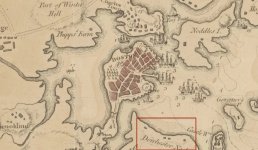
250 years ago today, George Washington is looking for someplace to employ the "noble train of artillery" (cannons taken from Fort Ticonderoga) which arrive in Cambridge on January 25th.
He inspects Dorchester Heights (in the red box below), southeast of Boston, as yet unoccupied by the British.
Siege-of-Boston-1775-1776-Boston-Map copy.jpg
From Dorchester Heights, colonial artillery can shut off Boston from Royal Navy ships trying to bring in supplies. Washington starts developing a plan ...
 
Meanwhile, in Congress, a committee consisting of John Dickinson, James Wilson, William Hooper, James Duane, and Robert Alexander was tasked to draft an address to the Inhabitants of the Colonies. It was meant to lead the public mind into the idea of Independence, of which the necessity was plainly foreseen by Congress. The address was presented on February 13, 1776, but, before it could be carried through Congress, the language became evidently short of the subsisting maturity for that measure, so it was not adopted. At a minimum, it represents the thoughts of the committee, especially Wilson, who seems to have been the primary author.
 
  • Like
Reactions: Huckleberry
To the Inhabitants of the Colonies … from their Delegates in Congress.

FRIENDS AND COUNTRYMEN. History, we believe, cannot furnish an Example of a Trust, higher and more important than that, which we have received from your Hands. It comprehends in it every Thing that can rouse the Attention and interest the Passions of a People, who will not reflect Disgrace upon their Ancestors nor degrade themselves, nor transmit Infamy to their Descendants. It is committed to us at a Time when every Thing dear and valuable to such a People is in imminent Danger. This Danger arises from those, whom we have been accustomed to consider as our Friends; who really were so, while they continued friendly to themselves; and who will again be so, when they shall return to a just Sense of their own Interests. The Calamities, which threaten us, would be attended with the total Loss of those Constitutions, formed upon the venerable Model of British Liberty, which have been long our Pride and Felicity. To avert those Calamities we are under the disagreeable Necessity of making temporary Deviations from those Constitutions.

Such is the Trust reposed in us. Much does it import you and us, that it be executed with Skill and with Fidelity. That we have discharged it with Fidelity, we enjoy the Testimony of a good Conscience. How far we have discharged it with Skill must be determined by you, who are our Principals and Judges, to whom we esteem it our Duty to render an Account of our Conduct. …

All Power was originally in the People—that all the Powers of Government are derived from them—that all Power, which they have not disposed of, still continues theirs… The Share of Power, which the King derives from the People, or, in other Words, the Prerogative of the Crown, is well known and precisely ascertained: It is the same in Great Britain, and in the Colonies. The Share of Power, which the House of Commons derives from the People, is likewise well known: The Manner in which it is conveyed is by Election. But the House of Commons is not elected by the Colonists; and therefore, from them that Body can derive no Authority.

Besides; the Powers, which the House of Commons receives from its Constituents, are entrusted by the Colonies to their Assemblies in the several Provinces. Those Assemblies have Authority to propose and assent to Laws for the Government of their Electors, in the same Manner as the House of Commons has Authority to propose and assent to Laws for the Government of the Inhabitants of Great Britain. Now the same collective Body cannot delegate the same Powers to distinct representative Bodies. The undeniable Result is, that the House of Commons neither has nor can have any Power deriv'd from the inhabitants of these Colonies.

In the Instance of levying imposing Taxes, this Doctrine is clear and familiar: It is true and just in every other Instance. If it would be incongruous and absurd, that the same Property should be liable to be taxed by two Bodies independent of each other; … The House of Commons—a Body which acts solely by derivative Authority—is supposed entitled to exert over you an Authority, which you cannot give, and which it cannot receive.

The Sentence of universal Slavery gone forth against you is; that the British Parliament have Power to make Laws, WITHOUT YOUR CONSENT, binding you in ALL Cases whatever. Your Fortunes, your Liberties, your Reputations, your Lives, every Thing that can render you and your Posterity happy, all are the Objects of the Laws: …

Delegates authorised by the several Provinces from Nova Scotia to Georgia to represent them and act in their Behalf, met in GENERAL CONGRESS.

It has been objected, that this Measure was unknown to the Constitution; that the Congress was, of Consequence, an illegal Body; and that its Proceedings could not, in any Manner, be recognised by the Government of Britain. To those, who offer this Objection, … we … propose, that they would explain the Principles of the Constitution, which warranted the Assemby of the Barons at RUNNINGMEDE, when MAGNA CHARTA was signed, the Convention-Parliament that recalled Charles 2d, and the Convention of Lords and Commons that placed King William on the Throne. …
In examining the Conduct of those who directed the Affairs of the Colonies at the Time when … it was said, they were preparing for a general Revolt, we find it an easy Undertaking to shew, that they merited no Reproach from the British Ministry by making any Preparations for that Purpose. … On which Side of this unnatural Controversy was the ominous Intimation first given, that it must be decided by Force? Were Arms and Ammunition imported into America, before the Importation of them was prohibited? What Reason can be assigned for this Prohibition, unless it be this, that those who made it had determined upon such a System of Oppression, as they knew, would force the Colonies into Resistance? …

The Sentiments of the Colonies, expressed in the Proceedings of their Delegates assembled in 1774 were far from being disloyal or disrespectful. Was it disloyal to offer a Petition to your Sovereign? …
Was the Agreement not to import Merchandise from Great Britain or Ireland; ... —was this a disrespectful or an hostile Measure? Surely we have a Right to withdraw or to continue our own Commerce. …

How improbable is it, that the Colonists, who have been happy, and have known their Happiness in the quiet Possession of their Liberties; who see no Situation more to be desired, … and whose warmest Wish is to be re-installed in the Enjoyment of that Freedom, which they claim and are entitled to as Men and as British Subjects…

The humble unaspiring Colonists asked only for "Peace, Liberty and Safety." This, we think, was a reasonable Request: Reasonable as it was, it has been refused. Our ministerial Foes, dreading the Effects, which our commercial Opposition might have upon their favourite Plan of reducing the Colonies to Slavery, were determined not to hazard it upon that Issue. They employed military Force to carry it into Execution. Opposition of Force by Force, or unlimited Subjection was now our only Alternative. Which of them did it become Freemen determined never to surrender that Character, to chuse? The Choice was worthily made. We wish for Peace—we wish for Safety: But we will not, to obtain either or both of them, part with our Liberty. The sacred Gift descended to us from our Ancestors: We cannot dispose of it: We are bound by the strongest Ties to transmit it, as we have received it, pure and inviolate to our Posterity. We have taken up Arms in the best of Causes. We have adhered to the virtuous Principles of our Ancestors, who expressly stipulated, in their Favour, and in ours, a Right to resist every Attempt upon their Liberties. …

Our Troops are animated with the Love of Freedom. They have fought and bled and conquered in the Discharge of their Duty as good Citizens as well as brave Soldiers. Regardless of the Inclemency of the Seasons, and of the Length and Fatigue of the March, they go, with Chearfulness, wherever the Cause of Liberty and their Country requires their Service. … When the Forms of our Governments are … perverted from their original Design; ought we to submit to this Perversion? Ought we to sacrifice the Forms, when the Sacrifice becomes necessary for preserving the Spirit of our Constitution? Or ought we to neglect and neglecting, to lose the Spirit by a superstitious Veneration for the Forms? We regard those Forms, and wish to preserve them as long as we can consistently with higher Objects: But much more do we regard essential Liberty, which, at all Events, we are determined not to lose, but with our Lives. …

We deem it an Honour to "have raised Troops, and collected a naval Force"; and, cloathed with the sacred Authority of the People, from WHOM all LEGITIMATE AUTHORITY proceeds "to have exercised legislative, executive and judicial Powers." For what Purposes were those Powers instituted? For your Safety and Happiness. You and the World will judge whether those Purposes have been best promoted by us; …

We are accused of carrying on the War "for the Purpose of establishing an independent Empire." We disavow the Intention. We declare, that what we aim at, and what we are entrusted by our Constituents you to pursue, is the Defence and the Re-establishment of the constitutional Rights of the Colonies. …

When the Hostilities commenced by the ministerial Forces …, we did not forget our Duty to his Majesty, …. Our Words are these: "But as we most ardently wish for a Restoration of the Harmony formerly subsisting between our Mother Country and these Colonies, the Interruption of which must at all Events, be exceedingly injurious to both Countries: …

Lest this Declaration should disquiet the Minds of our Friends and fellow Subjects in any Part of the Empire, we assure them that we mean not to dissolve that Union, which has so long and so happily subsisted between us, and which we sincerely wish to see restored. Necessity has not yet driven us into that desperate Measure, …

We are accused of aiming at Independence: But how is this Accusation supported? By the Allegations of your Ministers, not by our Actions. Give us Leave, most solemnly to assure you, that we have not yet lost Sight of the Object we have ever had in View, a Reconciliation with you on constitutional Principles, and a Restoration of that friendly Intercourse, which to the Advantage of both we till lately maintained." …

We are far from being insensible of the Advantages, which have resulted to the Colonies as well as to Britain from the Connexion which has hitherto subsisted between them: … It is a Connexion founded upon mutual Benefits; upon Religion, Laws, Manners, Customs and Habits common to both Countries. …

We are too much attached to the English Laws and Constitution, and know too well their happy Tendency to diffuse Freedom, Prosperity and Peace wherever they prevail, to desire an independent Empire. If one Part of the Constitution be pulled down, it is impossible to foretell whether the other Parts of it may not be shaken, and, perhaps overthrown.

We trace your Calamities to the House of Commons. They have undertaken to give and grant your Money. From a supposed virtual Representation in their House it is argued, that you ought to be bound by the Acts of the British Parliament in all Cases whatever. This is no Part of the Constitution. This is the Doctrine, to which we will never subscribe our Assent: …

Let all Communication of despotic Power through that Channel be cut off, and your Liberties will be safe. … Though an independent Empire is not our Wish; it may—let your Oppressors attend— it may be the Fate of our Countrymen and ourselves. … We shall keep our Eyes constantly and steadily fixed upon the Grand Object of the Union of the Colonies—THE RE-ESTABLISHMENT AND SECURITY OF THEIR CONSTITUTIONAL RIGHTS. Every Measure that we employ shall be directed to the Attainment of this great End: No Measure, necessary, in our Opinion, for attaining it, shall be declined. If any such Measure should, against our principal Intention, draw the Colonies into Engagements that may suspend or dissolve their Union with their fellow-Subjects in Great Britain, we shall lament the Effect; but shall hold ourselves justified in adopting the Measure. That the Colonies may continue connected, as they have been, with Britain, is our second Wish: Our first is—THAT AMERICA MAY BE FREE.'
 
  • Like
Reactions: Huckleberry
250 years ago today, the Continental Congress decides to emit four million more dollar bills to cover the expenses of the war.
This is another step in the downward spiral of fiscal disaster that is going to plague the colonies and then the United States for years to come. The colonies had no interest in the Continental Congress having the taxing power and were absolutely against taxing themselves to cover the expenses. Congress has little choice, but at the same time, they seem unable to grasp the idea that just continuing to print fiat currency will destroy the value of that currency. One member says, "Why should I tax my people, when we can just print money?"
In the not too distant future, the phrase "not worth a Continental" will become common for something that is as worth lass than one Continental Dollar, i.e. worthless.
 
  • Like
Reactions: Huckleberry
Advertisement

Trending content

Advertisement

Latest threads