YesThey all look pretty young to me.
I take it your dad is the tech sergeant, the one on the right in the 1st and 3rd photos?


75th anniversary of D-Day...
- Thread starter crimsonaudio
- Start date
You are using an out of date browser. It may not display this or other websites correctly.
You should upgrade or use an alternative browser.
You should upgrade or use an alternative browser.


March 24, 1945: Another part of Operation Plunder begins: Operation Varsity - a successful joint American, British and Canadian airborne operation which is the largest airborne operation in history to be conducted on a single day and in one location - successfully drops more than 16,000 paratroopers via several thousand aircraft. The plans call for the dropping of two divisions from the US XVIII Airborne Corps, to capture key territory and to generally disrupt German defenses to aid the advance of Allied ground forces. The two divisions will hold the territory they capture until relieved by advancing units of 21st Army Group, and then join in the general advance into northern Germany. The airlift consists of 541 transport aircraft containing airborne troops, and a further 1,050 troop-carriers towing 1,350 gliders. The 17th Airborne Division consists of 9,387 personnel, who are transported in 836 C-47 Skytrain transports, 72 C-46 Commando transports, and more than 900 Waco CG-4A gliders. The 6th Airborne Division consists of 7,220 personnel transported by 42 Douglas C-54 and 752 C-47 Dakota transport aircraft, as well as 420 Airspeed Horsa and General Aircraft Hamilcar gliders. This immense armada stretches more than 200 miles in the sky, taking 2 hours and 37 minutes to pass any given point, and is protected by some 2,153 Allied fighters from the US 9th Air Force and the RAF.
By the end of the day, the Rhine crossing assault of British 21st Army Group (Field Marshal Montgomery) has established a bridgehead more than five miles deep. The bombed-out town of Wesel is captured by troops of British 2nd Army which link up with the airborne detachments. The US 9th Army, also part of 21st Army Group, begins to cross the Rhine a little to the south of the British and Canadians forces, sealing off the Ruhr region in Germany.
Patton’s US 3rd Army attacks Geisnach, Lichtenberg, Heuchel, Uckerath, Menden, Borscheid, Gladbach, and Ober Bieber as US Navy LCVP craft ferry they troops across the Rhine. General Patton famously urinates into the Rhine River. Upon completing his crossing over a pontoon bridge, he takes some dirt on the far bank, emulating his favorite historical figure William the Conqueror.
US 1st Army continues assaulting across the Rhine in multiple locations and expanding bridgeheads and US 7th Army is clearing west bank of the Rhine and preparing to assault across the river.
Private George J. Peters wasserving in Company G, 507th Parachute Infantry Regiment, 17th Airborne Division. His unit is dropped by parachute across the Rhine river near Fluren, Germany. Immediately upon landing, Peters single-handedly attacks a German machine gun emplacement which was firing on his group. He succeeds in destroying the position despite being mortally wounded during his advance. He is posthumously awarded the Medal of Honor eleven months later, on February 8, 1946. Here is his citation:
“Pvt. Peters, a platoon radio operator with Company G, made a descent into Germany near Fluren, east of the Rhine. With 10 others, he landed in a field about 75 yards from a German machinegun supported by riflemen, and was immediately pinned down by heavy, direct fire. The position of the small unit seemed hopeless with men struggling to free themselves of their parachutes in a hail of bullets that cut them off from their nearby equipment bundles, when Pvt. Peters stood up without orders and began a 1-man charge against the hostile emplacement armed only with a rifle and grenades. His single-handed assault immediately drew the enemy fire away from his comrades. He had run halfway to his objective, pitting rifle fire against that of the machinegun, when he was struck and knocked to the ground by a burst. Heroically, he regained his feet and struggled onward. Once more he was torn by bullets, and this time he was unable to rise. With gallant devotion to his self-imposed mission, he crawled directly into the fire that had mortally wounded him until close enough to hurl grenades which knocked out the machinegun, killed 2 of its operators, and drove protecting riflemen from their positions into the safety of a woods. By his intrepidity and supreme sacrifice, Pvt. Peters saved the lives of many of his fellow soldiers and made it possible for them to reach their equipment, organize, and seize their first objective.â€Â
Peters was buried at the Netherlands American Cemetery, in Margraten, the Netherlands.
Serving in Company E of the 513th Parachute Infantry Regiment, 17th Airborne Division, Private First Class Stuart S. Stryker’s company attacked a strongly defended building near Wesel, Germany. When a platoon tasked with making a frontal assault became pinned down by intense fire, Stryker voluntarily ran to the head of the unit, called for the soldiers to follow him, and charged the German position. He was killed by hostile fire 25 yards from the building. His attack provided a diversion which allowed other elements of Company E to take the position, capturing over 200 soldiers and freeing three American airmen held as prisoners by the Germans. For these actions, Stryker was posthumously awarded the Medal of Honor nine months later, on December 11, 1945. Here is his citation:
“He was a platoon runner, when the unit assembled near Wesel, Germany after a descent east of the Rhine. Attacking along a railroad, Company E reached a point about 250 yards from a large building used as an enemy headquarters and manned by a powerful force of Germans with rifles, machineguns, and 4 field pieces. One platoon made a frontal assault but was pinned down by intense fire from the house after advancing only 50 yards. So badly stricken that it could not return the raking fire, the platoon was at the mercy of German machine gunners when PFC. Stryker voluntarily left a place of comparative safety, and, armed with a carbine, ran to the head of the unit. In full view of the enemy and under constant fire, he exhorted the men to get to their feet and follow him. Inspired by his fearlessness, they rushed after him in a desperate charge through an increased hail of bullets. Twenty-five yards from the objective the heroic soldier was killed by the enemy fusillades. His gallant and wholly voluntary action in the face of overwhelming firepower, however, so encouraged his comrades and diverted the enemy's attention that other elements of the company were able to surround the house, capturing more than 200 hostile soldiers and much equipment, besides freeing 3 members of an American bomber crew held prisoner there. The intrepidity and unhesitating self-sacrifice of PFC. Stryker were in keeping with the highest traditions of the military service.â€Â
Aged 20 at his death, Stryker was buried at Golden Gate National Cemetery in San Bruno, California. In 2002, the U.S. Army named its new armored fighting vehicle "Stryker" in honor of both Stuart Stryker and fellow Medal of Honor recipient Robert F. Stryker.
Over Germany, US 8th Air Force attacks German airfields with 1,033 bombers in the morning and German airfields and transportation targets with 443 bombers in the afternoon. US 15th Air Force attacks Neuberg jet aircraft factory with 271 bombers and Berlin with 150 bombers in its first mission to the German capital. US 12th Air Force aircraft attack Muhlberg and Steinach across the border from Italy. RAF Bomber Command sends 177 aircraft to attack Sterkrade during the day, 175 aircraft to attack Gladbeck during the day, 185 aircraft to attack Dortmund and Bottrop during the day, and 67 aircraft to attack Berlin overnight.
On the eastern front, in Hungary, Szekesfehervar falls to the attacks of troops of 2nd Ukrainian Front. Meanwhile, the front line of the Soviet offensive in this area has already pushed farther to the west, taking Veszprem and Mor. The German and Hungarian forces of German Army Group South are retreating in disorder after sustaining heavy losses. To the northeast, in Poland, Soviet forces capture Spolot on the Baltic coast between Gdynia and Danzig.
On Iwo Jima, US 28th Marine Regiment is reducing the final Japanese pocket, 50 yards by 50 yards, which continues to resist. Admiral Nimitz visits Iwo Jima.
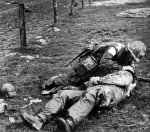
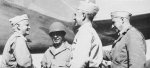
Pictured: C-47 Skytrain transport aircraft releasing hundreds of paratroopers and their supplies over the Rees-Wesel region in North Rhine-Westphalia, Germany during Operation Varsity, March 24, 1945.; A medic of the 17th ABN trying to save the life of a private during Operation Varsity, Wessel Germany, on the 24th of March 1945.; Medal Of Honor recipient George Peters’ headstone.; Medal Of Honor recipient Stuart Stryker's headstone.; Admiral Nimitz is greeted on Iwo Jima by Major General Schmidt, (shaking hands), Rear Admiral Hill (nearest camera), and Major General Chaney, USA, Garrison Force Commander (on right).



By the end of the day, the Rhine crossing assault of British 21st Army Group (Field Marshal Montgomery) has established a bridgehead more than five miles deep. The bombed-out town of Wesel is captured by troops of British 2nd Army which link up with the airborne detachments. The US 9th Army, also part of 21st Army Group, begins to cross the Rhine a little to the south of the British and Canadians forces, sealing off the Ruhr region in Germany.
Patton’s US 3rd Army attacks Geisnach, Lichtenberg, Heuchel, Uckerath, Menden, Borscheid, Gladbach, and Ober Bieber as US Navy LCVP craft ferry they troops across the Rhine. General Patton famously urinates into the Rhine River. Upon completing his crossing over a pontoon bridge, he takes some dirt on the far bank, emulating his favorite historical figure William the Conqueror.
US 1st Army continues assaulting across the Rhine in multiple locations and expanding bridgeheads and US 7th Army is clearing west bank of the Rhine and preparing to assault across the river.
Private George J. Peters wasserving in Company G, 507th Parachute Infantry Regiment, 17th Airborne Division. His unit is dropped by parachute across the Rhine river near Fluren, Germany. Immediately upon landing, Peters single-handedly attacks a German machine gun emplacement which was firing on his group. He succeeds in destroying the position despite being mortally wounded during his advance. He is posthumously awarded the Medal of Honor eleven months later, on February 8, 1946. Here is his citation:
“Pvt. Peters, a platoon radio operator with Company G, made a descent into Germany near Fluren, east of the Rhine. With 10 others, he landed in a field about 75 yards from a German machinegun supported by riflemen, and was immediately pinned down by heavy, direct fire. The position of the small unit seemed hopeless with men struggling to free themselves of their parachutes in a hail of bullets that cut them off from their nearby equipment bundles, when Pvt. Peters stood up without orders and began a 1-man charge against the hostile emplacement armed only with a rifle and grenades. His single-handed assault immediately drew the enemy fire away from his comrades. He had run halfway to his objective, pitting rifle fire against that of the machinegun, when he was struck and knocked to the ground by a burst. Heroically, he regained his feet and struggled onward. Once more he was torn by bullets, and this time he was unable to rise. With gallant devotion to his self-imposed mission, he crawled directly into the fire that had mortally wounded him until close enough to hurl grenades which knocked out the machinegun, killed 2 of its operators, and drove protecting riflemen from their positions into the safety of a woods. By his intrepidity and supreme sacrifice, Pvt. Peters saved the lives of many of his fellow soldiers and made it possible for them to reach their equipment, organize, and seize their first objective.â€Â
Peters was buried at the Netherlands American Cemetery, in Margraten, the Netherlands.
Serving in Company E of the 513th Parachute Infantry Regiment, 17th Airborne Division, Private First Class Stuart S. Stryker’s company attacked a strongly defended building near Wesel, Germany. When a platoon tasked with making a frontal assault became pinned down by intense fire, Stryker voluntarily ran to the head of the unit, called for the soldiers to follow him, and charged the German position. He was killed by hostile fire 25 yards from the building. His attack provided a diversion which allowed other elements of Company E to take the position, capturing over 200 soldiers and freeing three American airmen held as prisoners by the Germans. For these actions, Stryker was posthumously awarded the Medal of Honor nine months later, on December 11, 1945. Here is his citation:
“He was a platoon runner, when the unit assembled near Wesel, Germany after a descent east of the Rhine. Attacking along a railroad, Company E reached a point about 250 yards from a large building used as an enemy headquarters and manned by a powerful force of Germans with rifles, machineguns, and 4 field pieces. One platoon made a frontal assault but was pinned down by intense fire from the house after advancing only 50 yards. So badly stricken that it could not return the raking fire, the platoon was at the mercy of German machine gunners when PFC. Stryker voluntarily left a place of comparative safety, and, armed with a carbine, ran to the head of the unit. In full view of the enemy and under constant fire, he exhorted the men to get to their feet and follow him. Inspired by his fearlessness, they rushed after him in a desperate charge through an increased hail of bullets. Twenty-five yards from the objective the heroic soldier was killed by the enemy fusillades. His gallant and wholly voluntary action in the face of overwhelming firepower, however, so encouraged his comrades and diverted the enemy's attention that other elements of the company were able to surround the house, capturing more than 200 hostile soldiers and much equipment, besides freeing 3 members of an American bomber crew held prisoner there. The intrepidity and unhesitating self-sacrifice of PFC. Stryker were in keeping with the highest traditions of the military service.â€Â
Aged 20 at his death, Stryker was buried at Golden Gate National Cemetery in San Bruno, California. In 2002, the U.S. Army named its new armored fighting vehicle "Stryker" in honor of both Stuart Stryker and fellow Medal of Honor recipient Robert F. Stryker.
Over Germany, US 8th Air Force attacks German airfields with 1,033 bombers in the morning and German airfields and transportation targets with 443 bombers in the afternoon. US 15th Air Force attacks Neuberg jet aircraft factory with 271 bombers and Berlin with 150 bombers in its first mission to the German capital. US 12th Air Force aircraft attack Muhlberg and Steinach across the border from Italy. RAF Bomber Command sends 177 aircraft to attack Sterkrade during the day, 175 aircraft to attack Gladbeck during the day, 185 aircraft to attack Dortmund and Bottrop during the day, and 67 aircraft to attack Berlin overnight.
On the eastern front, in Hungary, Szekesfehervar falls to the attacks of troops of 2nd Ukrainian Front. Meanwhile, the front line of the Soviet offensive in this area has already pushed farther to the west, taking Veszprem and Mor. The German and Hungarian forces of German Army Group South are retreating in disorder after sustaining heavy losses. To the northeast, in Poland, Soviet forces capture Spolot on the Baltic coast between Gdynia and Danzig.
On Iwo Jima, US 28th Marine Regiment is reducing the final Japanese pocket, 50 yards by 50 yards, which continues to resist. Admiral Nimitz visits Iwo Jima.
Pictured: C-47 Skytrain transport aircraft releasing hundreds of paratroopers and their supplies over the Rees-Wesel region in North Rhine-Westphalia, Germany during Operation Varsity, March 24, 1945.; A medic of the 17th ABN trying to save the life of a private during Operation Varsity, Wessel Germany, on the 24th of March 1945.; Medal Of Honor recipient George Peters’ headstone.; Medal Of Honor recipient Stuart Stryker's headstone.; Admiral Nimitz is greeted on Iwo Jima by Major General Schmidt, (shaking hands), Rear Admiral Hill (nearest camera), and Major General Chaney, USA, Garrison Force Commander (on right).


War puts young men in tough positions, in which, if they decide incorrectly they die themselves or kill someone innocent.Holy Christ... what can you say?
I could probably find an instance in which a soldier restrains himself and gets killed as a result, except this guys generally do not live to tell the tale.
An American airborne division was supposed to have three parachute infantry regiments and a glider infantry regiment. the 17th in Op VARSITY had two PIRs (507th, 513th) and one GIR (194th).March 24, 1945: Another part of Operation Plunder begins: Operation Varsity - a successful joint American, British and Canadian airborne operation which is the largest airborne operation in history to be conducted on a single day and in one location - successfully drops more than 16,000 paratroopers via several thousand aircraft.
Pictured: C-47 Skytrain transport aircraft releasing hundreds of paratroopers and their supplies over the Rees-Wesel region in North Rhine-Westphalia, Germany during Operation Varsity, March 24, 1945.
View attachment 6763
I am not sure why the Allies opted for a daylight drop.Maybe they thought the assembly phase was easier in Op MARKET-GARDEN. There were two main reasons why I would have urged a night drop.
1. The closer you drop behind enemy lines, the more enemy AAA there is. Drop deep, drop safe. Drop close and all the AAA protecting the front lines can also fire on the transport aircraft.
2. The Allies had the ability to fly over friendly-held territory 99% of the route to the DZs. (The DZs were ~13 km across the Rhine, so short a distance, even a C-47 pilot could not get lost.) There were ample opportunities to aid the pilots at following the planned flight path: ground lights, radio beacons, etc.
As it was, the Jerries' AAA shot the crap out of the planes. One ground crew when the C-47 got back to base counted bullet holes in the airplane. They stopped counting at 200.


The last week, I have appreciated this thread as a diversion from the world’s ills (pun intended) and force my self with some fresh perspective on what this brave young men and women went thru.
The aircraft losses were 56 total out of 1,700 or 3.2%. That does not sound bad, but every veteran's account mentions the terrible flak and mentions seeing some aircraft literally going down in flames. On D+1, 560 B-24s pressed into service as cargo droppers lost 15 more aircraft.My brother used to say the flak was so thick it looked like you could walk on it...
When Matt Ridgway (CG, XVIII Airborne Corps) got to the DZ (by land, compliments of the British 15th ID) and got briefed on the drops, he directed that airborne troops never agAin use C-46s for combat personnel drops because of their combustibility.
On the other hand, glider aircraft were a mess. I learned that Waco's and Horsa's had a compressed air system for lowering the wing flaps for landing. I noticed over and over that the Jerry's AAA took out the compressed air system and the gliders had to land with flaps up.
Every glider is crashed to some degree, but there seemed to be a lot of glider crashes. There were unanticipated wire fences across several of the glider landing zones, and these caused gliders to land awkwardly, or jam up the glider opening mechanism so the passengers could get their cargoes out.
Charles B. MacDonald company commander in the 28th ID, veteran of the Huertgen and Ardennes, and prolific post-war historian asked in The Last Offensive, whether VARSITY was worth the effort. The 30th and 79th IDs had crossed the river elsewhere with but 41 fatalities. VARSITY cost 737 dead (plus x3 wounded). The airborne troops captured 3,500 Germans and killed/wounded probably as many more.
I have not counted how many of those airborne casualties were between boarding at Air Ports of Embarkation (APOEs) to getting out of their parachute harnesses or gliders on the DZs/LZs (not even sure those data are available). I would guess a lot of them (maybe the majority) were just the sunk cost of doing an airborne drop (crashed airplanes, planes shot down before the paras could get out, men trapped in burning gliders on the LZ, and men hung up in trees and shot by Germans before they could get out of their harnesses). Seems costly.
I guess the insurance policy is worth the cost, to make sure that the British crossing succeeded. The fact that, once the landings are completed, it was something of a walkover is beside the point. Beforehand, they did not know it would be a walkover. When it comes to getting across the Rhine, the Allies needed to be certain.
Last edited:

To be fair, my brother's tour was earlier, when casualties were much higher and the Luftwaffe was much more active. He told me that his wing suffered 300% casualties during his tour. I think someone questioned how that was possible the last time I posted it. It was just what he told me. My assumption was that that was the total number of airmen lost as a gross number. Also, you have to believe that our bombing of their AA installations had to have some effect on it, by this point in the war...The aircraft losses were 56 total out of 1,700 or 3.2%. That does not sound bad, but every veteran's account mentions the terrible flak and mentions seeing some aircraft literally going down in flames. On D+1, 560 B-24s pressed into service as cargo droppers lost 15 more aircraft.
When Matt Ridgway (CG, XVIII Airborne Corps) got to the DZ (by land, compliments of the British 15th ID) and got briefed on the drops, he directed that airborne troops never agin use C-46s for combat personnel drops.
On the other hand, glider aircraft were a mess. I learned that Waco's and Horsa's had a compressed air system for lowering the wing flaps for landing. I noticed over and over that the Jerry's AAA took out the compressed air system and the gliders had to land with flaps up.
Every glider is crashed to some degree, but there seemed to be a lot of glider crashes. There was unanticipated wire fences across several of the glider landing zones, and these caused gliders to land awkwardly, or jam up the glider opening mechanism so the passengers could get their cargoes out.
Charles B. MacDonald company commander in the 28th ID, veteran of the Huertgen and Ardennes, and prolific post-war historian asked in The Last Offensive, whether VARSITY was worth the effort. The 30th and 79th IDs had crossed the river elsewhere with but 41 fatalities. VARSITY cost 737 dead (plus x3 wounded). The airborne troops captured 3,500 Germans and killed/wounded probably as many more.
have not counted how many of those airborne casualties were between boarding at Air Ports of Embarkation (APOEs) to getting out of their parachute harnesses or gliders on the DZs/LZs. I would guess a lot of them (maybe the majority) were just the sunk cost of doing an airborne drop.
I guess the insurance policy is worth the cost, to make sure that the British crossing succeeded. The fact that, once the landings are completed, it was something of a walkover is beside the point. Beforehand, they did not know it would be a walkover. When it comes to getting across the Rhine, the Allies needed to be certain.
You are absolutely correct. A "wing" contains a certain number of men at any given time.To be fair, my brother's tour was earlier, when casualties were much higher and the Luftwaffe was much more active. He told me that his wing suffered 300% casualties during his tour. I think someone questioned how that was possible the last time I posted it. It was just what he told me. My assumption was that that was the total number of airmen lost as a gross number.
300% over the course of his tour is a cumulation over time.
Plus, whenever talking casualties, you have to differentiate between killed, captured, wounded so badly they had to be sent home, and wounded RTD (Return to Duty). All are "casualties."
Some will return to duty and may even get wounded again, so one man can be a casualty twice. Some replacements replace the killed and captured, and they in turn became casualties of one type or another.
I do not doubt your brother's statistics.
In fact, I bet someone in the G-1 (Personnel section) tallied the data.
True, but the more pounding the Allies gave Germany from the air, the more powerful incentive to expend precious effort in producing more AAA.Also, you have to believe that our bombing of their AA installations had to have some effect on it, by this point in the war...
The Americans had the opposite effect. The near absence of the Luftwaffe over American army units made American AAA superfluous and many AAA gunners were involuntarily converted to infantry to make up the losses in that branch.
Last edited:
March 25, 1945: On the western front, results from Operation Plunder continue to impress. During the day, the various crossings of British 21st Army Group are consolidated into a single bridgehead, 30 miles wide. Further south, US 1st Army units, principally from US 3rd Corps, begin to break out of the Remagen bridgehead. The US 8th Corps (part of US 3rd Army) begins to cross the Rhine River near Boppard. To the south, Darmstadt is taken by US 12th Corps units who crossed at Nierstein. Other units have advanced farther east to the Main near Hanau and Aschaffenburg. US 9th Army pushes more troops across the Rhine, conducts another assault crossing, and expands bridgeheads while US 7th Army prepares to assault across the Rhine.
Winston Churchill, accompanied by Field Marshal Bernard Montgomery, crosses the Rhine River in Germany, visiting HQ 21st Army Group and delivering a characteristic message to officers and men.
Over Germany, US 8th Air Force attacks oil facilities with 243 bombers, but 737 other bombers are recalled due to poor weather conditions. RAF Bomber Command sends 275 aircraft to attack Hannover during the day, 175 aircraft to attack Munster during the day, and 156 aircraft to attack Osnabruk during the day.
On the Soviet front, in East Prussia, Keiligenbeil falls to units of the 3rd Belorussian Front, who pin remnants of German 4th Army into small pocket along the coast. Soviet 2nd Belorussian Front continues blasting the Gotenhafen (Gdynia) pocket and Danzig pocketIn Hungary, the Soviet offensive continues with the capture of Esztergom on the Danube River. Just north of the Danube, there are attacks by other elements of 3rd Ukrainian Front. The Soviet 2nd Ukrainian Front opens a new offensive against German 8th Army, crossing the Hron River and pushing toward Bratislava.
On Iwo Jima, US 28th Marine Regiment smashes the final Japanese pocket, completing combat operations on the island. General Tadamichi Kuribayashi passes away - reportedly committing ritual suicide, but his body is never found.
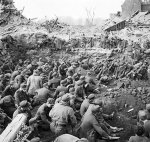
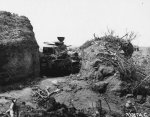
Pictured: A pair of German tank destroyer Jagdpanzer IV/70 (A), captured by the U.S. 1st Army in the vicinity of Oberpleis, (east of Bonn) Germany. March 25, 1945.; Large group of German prisoners of war sitting together in a compound after being captured by the Western Allies, March 25, 1945.; Winston Churchill on the east bank of the Rhine River after crossing, south of Wesel, North Rhine-Westphalia, Germany, March 25, 1945.; A Japanese tank wedged between banks of solid earth was very difficult for US Marines to see or attack from the front, Iwo Jima, Mar 25, 1945.


Winston Churchill, accompanied by Field Marshal Bernard Montgomery, crosses the Rhine River in Germany, visiting HQ 21st Army Group and delivering a characteristic message to officers and men.
Over Germany, US 8th Air Force attacks oil facilities with 243 bombers, but 737 other bombers are recalled due to poor weather conditions. RAF Bomber Command sends 275 aircraft to attack Hannover during the day, 175 aircraft to attack Munster during the day, and 156 aircraft to attack Osnabruk during the day.
On the Soviet front, in East Prussia, Keiligenbeil falls to units of the 3rd Belorussian Front, who pin remnants of German 4th Army into small pocket along the coast. Soviet 2nd Belorussian Front continues blasting the Gotenhafen (Gdynia) pocket and Danzig pocketIn Hungary, the Soviet offensive continues with the capture of Esztergom on the Danube River. Just north of the Danube, there are attacks by other elements of 3rd Ukrainian Front. The Soviet 2nd Ukrainian Front opens a new offensive against German 8th Army, crossing the Hron River and pushing toward Bratislava.
On Iwo Jima, US 28th Marine Regiment smashes the final Japanese pocket, completing combat operations on the island. General Tadamichi Kuribayashi passes away - reportedly committing ritual suicide, but his body is never found.
Pictured: A pair of German tank destroyer Jagdpanzer IV/70 (A), captured by the U.S. 1st Army in the vicinity of Oberpleis, (east of Bonn) Germany. March 25, 1945.; Large group of German prisoners of war sitting together in a compound after being captured by the Western Allies, March 25, 1945.; Winston Churchill on the east bank of the Rhine River after crossing, south of Wesel, North Rhine-Westphalia, Germany, March 25, 1945.; A Japanese tank wedged between banks of solid earth was very difficult for US Marines to see or attack from the front, Iwo Jima, Mar 25, 1945.
For a tank destroyer yes. However, for a dynamic armored vehicle on the move, you need to be able to fire your main gun over a wider arch.That turretless design really makes a lot of sense...
The height was 6" 1', which is good.That turretless design really makes a lot of sense...
The cannon left and right traverse was a limiting factor.
When you dig a hull-down and (the deeper) turret down position, cannon traverse is an issue. The turreted American tank decoyers could use hull down or turret down positions and, even if the enemy came from an unexpected direction then the hull-down position was still useful.
For a turret less design, the hull-down position could suddenly become useless to a turret less tank, but not to a turreted TD.
I guess the big advantage of the turretless design is that the casemate armor could be (and was) thicker, especially to the front.
The armor on American TDs was notoriously thin. The tracked vehicle was just a way to move the AT cannon around the battlefield. It was not a tank, even though commanders frequently wanted to fight them as tanks.

You missed a month somewhere.I know this is D Day and Europe but Harry Smith did a good video report on raising the flag at Iwo Jima 75 years ago today. We lost 7,000 troops in 2 weeks...the Japanese lost 20,000.

Document for February 23rd:
Photograph of Flag Raising on Iwo Jima, 02/23/1945

Photograph of Flag Raising on Iwo Jima, 02/23/1945
Photograph of Flag Raising on Iwo Jima, 02/23/1945 (NWDNS-80-G-413988; National Archives Identifier: 520748); General Photographic File of the Department of Navy, 1943 - 1958; General Records of the Department of the Navy, 1804 - 1958; Record Group 80; National Archives.
You're a little late to the thread, but we've beaten this issue to death. As TW notes, the similarity to a tank led many commanders to use them as tanks, rather than as tank destroyers. The turret also limited the size of gun which could be mounted and gave problems with its slow, hand-cranked rotation. They finally got it mostly right with the M36, which remained in service long after the war. The M10 was not a popular vehicle in the Hürtgen, when the German air bursts in the trees showered the open turrets with shrapnel...For a tank destroyer yes. However, for a dynamic armored vehicle on the move, you need to be able to fire your main gun over a wider arch.
I was curious why Churchill wore military uniforms at times and came across this site.

 charlesmccain.com
This picture from the site is from 75 years ago today, probably just a minute or two before the one posted above.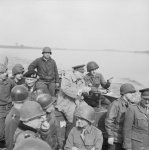
Churchill Loved His Uniforms
Having begun his adult life as a soldier, Churchill remained keen on uniforms for the remainder of his life and often wore them in the Second World War. He only wore uniforms he was entitled to and his ranks at that point were honorary. Prime
charlesmccain.com
This picture from the site is from 75 years ago today, probably just a minute or two before the one posted above.
A lot of Americans in that photo for a crossing in 21st Army Group op.I was curious why Churchill wore military uniforms at times and came across this site.
Churchill Loved His Uniforms
Having begun his adult life as a soldier, Churchill remained keen on uniforms for the remainder of his life and often wore them in the Second World War. He only wore uniforms he was entitled to and his ranks at that point were honorary. Prime
This picture from the site is from 75 years ago today, probably just a minute or two before the one posted above. View attachment 6784
The Germans put a long-barrel 88mm in a Mark IV Chassis, and called it the Nashorn, but it was tall. Very tall.You're a little late to the thread, but we've beaten this issue to death. As TW notes, the similarity to a tank led many commanders to use them as tanks, rather than as tank destroyers. The turret also limited the size of gun which could be mounted and gave problems with its slow, hand-cranked rotation.
The armor is probably sufficient to protect the crew from artillery fragments, and maybe rifle fire, but not antitank fire.In other words, the crew had to be very careful where the employed their cannon.
A Nashorn destroyed a Pershing in 1945, which was maybe the only Pershing tank destroyed by enemy fire in the war.
Last edited:
Here is the caption for the picture.A lot of Americans in that photo for a crossing in 21st Army Group op.
Prime Minister Winston Churchill Crosses the River Rhine, Germany 1945
The Prime Minister Winston Churchill crosses the River Rhine to the east bank, south of Wesel, in an American Landing Craft Vehicle Personnel (or Higgins boat) with Field Marshal Sir Bernard Montgomery, Field Marshal Sir Alan Brooke and US General William Simpson on 25 March 1945. (photo courtesy of the Imperial War Museum).


Trending content
-
-

-
-

-

-

-
 Thread 'Why has Bama been terrible on both sides of the line for 4 or 5 years?'
- SMOKIESBAMAFAN
Replies: 47 -

Latest threads
-
 ESPN: Tide's DeBoer: No interest in other job openings
- Started by TideFans Reporter
- Replies: 0
-
-
ESPN: College football bowl season: MVP picks for all 36 matchups
- Started by TideFans Reporter
- Replies: 0
-
ESPN: Washington staying with Terrapins for '26 season
- Started by TideFans Reporter
- Replies: 0
-
ESPN: Way-too-early 2026 Heisman watch: 15 players who could win the award
- Started by TideFans Reporter
- Replies: 0
-
ESPN: QB Mendoza first Hoosier to win Heisman Trophy
- Started by TideFans Reporter
- Replies: 0