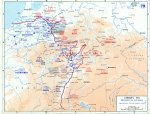
March 28, 1945: On the western from, the Allies continue the push into Germany as US 1st Army continues its rapid advance from the Remagen bridgehead and captures Marburg, while US 3rd Army captures Limburg am Lahn. Meanwhile, British 2nd Army begins an offensive towards the Elbe River. British sappers build another Rhine bridge, "Blackfriars", by noon. Behind the lines, Dwight Eisenhower transfers US 9th Army from Bernard Montgomery's army group to Omar Bradley's army group as Anglo-American objective shifts toward southern Germany and Czechoslovakia. US 9th Army attacks around Dorsten, Kirchhellen, Hamborn, and Neumuhl while US 7th Army attacks toward Aschaffenburg, Mannheim, and Heidelberg.
In addition to besieging the German fortress ports at Lorient and St. Nazaire, US 15th Army is ordered to control occupied territory as more of Germany falls into Allied hands.
Over Germany, US 8th Air Force attacks Berlin with 383 bombers, Hannover with 465 bombers, and targets of opportunity with 43 bombers.
To the east, Soviet 1st Belorussian Front captures Danzig (now Gdansk), yielding 9,000 prisoners of war. Gdynia falls to forces of the Soviet 2nd Belorussian Front. Soviet 3rd Belorussian Front captures Balga, completing destruction of German 4th Army (except those elements evacuated by sea) along East Prussian coast. In Hungary, just south of the Danube River, Gyor is captured by troops from the 2nd Ukrainian Front. while Soviet 3rd Ukrainian Front continues attacking German Army Group South and pushing beyond the Raab River.
Stalin receives a personal telegram from General Eisenhower (Supreme Allied Commander of the Allied Expeditionary Force) giving details of his order of battle and saying that he intends to send the main weight of his advance across southern Germany and Austria. The main thrust is to be toward Erfurt and Leipzig and a secondary effort is to go for Nuremberg, Regensburg and Linz. This effectively leaves the capture of Berlin to the Soviets. The British protest the signal sent to Stalin, suggesting that decisions of such importance should not be taken by Eisenhower alone and that he also overstepping the authority in communicating directly with the Soviets. Both Churchill and the British Chiefs of Staff would prefer the advance to be directed on Berlin as had been the plan up to now for the political value of this move. However, President Roosevelt, weakened by his illness, leaves most military decisions to General Marshall and the Joint Chiefs of Staff. Marshall confirms his support for Eisenhower in response to the British protest.
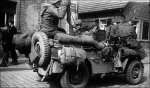
Pictured: A Sherman tank crosses a scissors bridge near Meiktila, March 28, 1945.; From left, Harry Goldsmith, Lawrence Czarnota, Cecil New and Glenn Kappelman bring two captured Germans, sitting on the front hood, into a Main River village. The photo was taken March 28, 1945, east of Offenbach, Germany.; Patton, Bradley, Hodges, and Eisenhower, Germany, March 28, 1945.; Map depicting the crossing of the Rhine, 22-28 Mar 1945.