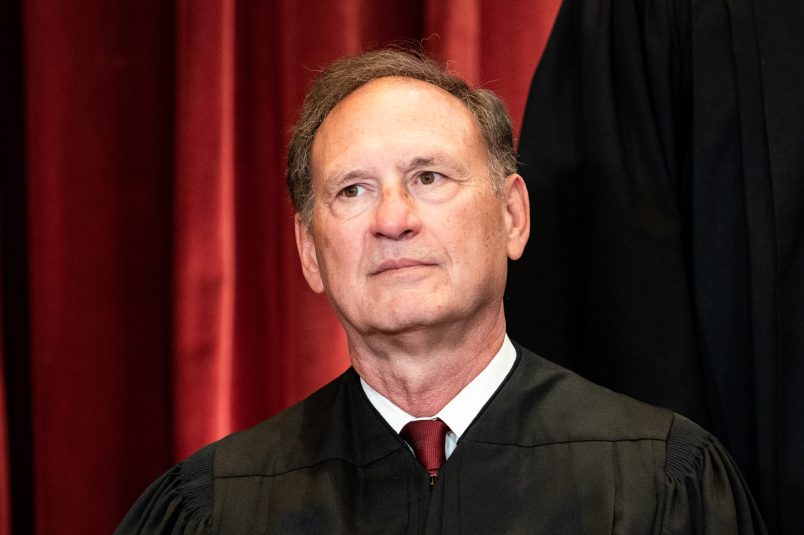
News Article: Alito: Congress Can't Tell SC What to Do

jthomas666

TideFans Legend
Aug 14, 2002
25,548
15,788
287
62
Birmingham & Warner Robins

Another op/ed in the WSJ (which is paywalled).

The sheer arrogance on display is astounding.
 
this seems to suggest otherwise

In all Cases affecting Ambassadors, other public Ministers and Consuls, and those in which a State shall be Party, the supreme Court shall have original Jurisdiction. In all the other Cases before mentioned, the supreme Court shall have appellate Jurisdiction, both as to Law and Fact, with such Exceptions, and under such Regulations as the Congress shall make.
 

Another op/ed in the WSJ (which is paywalled).

The sheer arrogance on display is astounding.
even worse than that, one of the op/ed writers that interviewed him is a lawyer that has a case coming up before the court


Alito spoke with attorney David B. Rivkin Jr., the attorney, and a Wall Street Journal opinion editor for an interview published on the Wall Street Journal’s opinion page.

Rivkin regularly writes for the Journal’s opinion section, and is an attorney at law firm Baker Hostetler. It’s there that he has a key item of business before the Court: he’s part of a team representing the plaintiffs in Moore v. U.S., a case which asks the Court to upend the country’s tax system and potentially foreclose a wealth tax of the sort some Democrats have championed in recent years.
 
this seems to suggest otherwise
That clause seems to be about how the Court can go about deciding cases under it appellate jurisdiction.
That said, I wish Congress would assert its authority by declining to pay the bills of the Supreme Court. Try holding court with no electricity, no heat/AC, no clerks, and no paper, computers, pens, pencils, etc. The Supreme Court is the only federal court whose existence is due to Constitution, but Congress has budgetary authority, and I wish Congress would assert its authority, just once, when a subordinate or co-equal branch tells Congress to jump in a lake. Just once.

Civics lessons say that one of the checks and balances between the three co-equal branches is that Congress holds the purse strings. Okay, Congress, to quote Khan Noonien Singh, "explain it to them." That would be fun to watch.
Congress just rolls over and takes whatever abuse others decide to dish out yet still pays their bills. What good is the check if it is never used and opponents flaunt it.

 
What makes all of this so infuriating is that Alito and Thomas honestly think they can do whatever they want. "Ethics, shmethics." You'd think Roberts would have enough presence of mind to address the problem.
 
Last edited:
  • Like
Reactions: 92tide
That clause seems to be about how the Court can go about deciding cases under it appellate jurisdiction.
That said, I wish Congress would assert its authority by declining to pay the bills of the Supreme Court. Try holding court with no electricity, no heat/AC, no clerks, and no paper, computers, pens, pencils, etc. The Supreme Court is the only federal court whose existence is due to Constitution, but Congress has budgetary authority, and I wish Congress would assert its authority, just once, when a subordinate or co-equal branch tells Congress to jump in a lake. Just once.

Civics lessons say that one of the checks and balances between the three co-equal branches is that Congress holds the purse strings. Okay, Congress, to quote Khan Noonien Singh, "explain it to them." That would be fun to watch.
Congress just rolls over and takes whatever abuse others decide to dish out yet still pays their bills. What good is the check if it is never used and opponents flaunt it.

The problem is that one side or the other approves/disapproves of every decision, ergo you'll never get the majorities for a move like that...
 
  • Like
Reactions: PaulD
The problem is that one side or the other approves/disapproves of every decision, ergo you'll never get the majorities for a move like that...
I would still like to see Congress assert that authority just once.
I would also like to see the Supreme Court try to force Congress to spend money on them. Congress cannot modify the salaries of the court members. Everything else is the gift of the people of the United States via their elected representatives. It would lead to some interesting constitutional discussions.
 
I would still like to see Congress assert that authority just once.
I would also like to see the Supreme Court try to force Congress to spend money on them. Congress cannot modify the salaries of the court members. Everything else is the gift of the people of the United States via their elected representatives. It would lead to some interesting constitutional discussions.
So would I. I'm not holding my breath, though...
 
There was a typhoon that hit the big island in Hawaii. The commander of the 25th Infantry Division on Oahu sent his Assistant Division Commander (a one-star general) on a helicopter to meet with the governor and coordinate whatever "military support to civilian authorities" the governor might request.
When the governor saw the general on the big island, he said, "Nobody has requested any support from the Army. Get back on you helicopter and return to Oahu, General."
As soon as the general landed in Oahu, the governor requested the 25th ID send an officer to coordinate requested support.
The governor was not being a jerk. He was asserting his prerogatives as the civilian authority in Hawaii.

Congress could adopt some ethics and transparency rules and pass a resolution stating, "We recommend these ethics rules to the Supreme Court. We believe we have authority to direct them. Members of the Court have denied that authority. We will not resolve that question here, but until the Court adopts updated ethics rules, the people of the United States through their elected representatives will not appropriate funds to pay for clerks, electricity, water, officer supplies, telephone service, etc. We look forward to the speedy adoption of enhanced ethics and transparency rules."

In fairness when I see what appears to be insubordination, it is like a bull seeing a red flag.
 
There was a typhoon that hit the big island in Hawaii. The commander of the 25th Infantry Division on Oahu sent his Assistant Division Commander (a one-star general) on a helicopter to meet with the governor and coordinate whatever "military support to civilian authorities" the governor might request.
When the governor saw the general on the big island, he said, "Nobody has requested any support from the Army. Get back on you helicopter and return to Oahu, General."
As soon as the general landed in Oahu, the governor requested the 25th ID send an officer to coordinate requested support.
The governor was not being a jerk. He was asserting his prerogatives as the civilian authority in Hawaii.

Congress could adopt some ethics and transparency rules and pass a resolution stating, "We recommend these ethics rules to the Supreme Court. We believe we have authority to direct them. Members of the Court have denied that authority. We will not resolve that question here, but until the Court adopts updated ethics rules, the people of the United States through their elected representatives will not appropriate funds to pay for clerks, electricity, water, officer supplies, telephone service, etc. We look forward to the speedy adoption of enhanced ethics and transparency rules."

In fairness when I see what appears to be insubordination, it is like a bull seeing a red flag.
As I said, they would have to PO both parties at once. It looks like they're trying...
 
IMO this is an issue that goes beyond all party affiliation. No, neither Congress nor the President can dictate how the SCOTUS rules concerning the meaning of the Constitution. That we all agree. However, prudence would seem to indicate that the other 2 branches can insist on a joint ethical standard that would apply across the board to all governmental officials, elected, appointed or otherwise. Notice how I expanded the application so that no one can feel attacked or slighted?

I will not hold my breath...
 
IMO this is an issue that goes beyond all party affiliation. No, neither Congress nor the President can dictate how the SCOTUS rules concerning the meaning of the Constitution. That we all agree. However, prudence would seem to indicate that the other 2 branches can insist on a joint ethical standard that would apply across the board to all governmental officials, elected, appointed or otherwise. Notice how I expanded the application so that no one can feel attacked or slighted?

I will not hold my breath...
I like it.
 
  • Thank You
Reactions: Padreruf
Senator Tuberville is just the man for the job

There was a typhoon that hit the big island in Hawaii. The commander of the 25th Infantry Division on Oahu sent his Assistant Division Commander (a one-star general) on a helicopter to meet with the governor and coordinate whatever "military support to civilian authorities" the governor might request.
When the governor saw the general on the big island, he said, "Nobody has requested any support from the Army. Get back on you helicopter and return to Oahu, General."
As soon as the general landed in Oahu, the governor requested the 25th ID send an officer to coordinate requested support.
The governor was not being a jerk. He was asserting his prerogatives as the civilian authority in Hawaii.

Congress could adopt some ethics 8jki transparency rules and pass a resolution stating, "We recommend these ethics rules to the Supreme Court. We believe we have authority to direct them. Members of the Court have denied that authority. We will not resolve that question here, but until the Court adopts updated ethics rules, the people of the United States through their elected representatives will not appropriate funds to pay for clerks, electricity, water, officer supplies, telephone service, etc. We look forward to the speedy adoption of enhanced ethics and transparency rules."

In fairness when I see what appears to be insubordination, it is like a bull seeing a red flag.
 
I think it’s hilarious that Congress is trying to impose ethics on SCOTUS, while consistently advocating that they themselves should be able to trade stocks while possessing what would be classified as inside information if possessed by anyone else. IOW, it would be illegal insider trading, except for the fact that they’re in Congress.

Let that last sentence sink in for a minute.

So says Congress: SCOTUS, we’re going to legislate you doing the right thing. But us? Are you kidding? Ethics for thee, not for me.

FTR: I think SCOTUS should have a code of ethics with some teeth in it. I’m on record advocating that every holder of any federal elected office, or any appointed office requiring Congressional approval, should have to file a comprehensive financial disclosure, AND have their tax return be a public document, AND be required to put all their assets, and their spouse’s, in a blind trust for the duration of their service.

I just find the Congress / SCOTUS hypocrisy sweet enough to rot teeth.
 
Last edited:
I think it’s hilarious that Congress is trying to impose ethics on SCOTUS, while consistently advocating that they themselves should be able to trade stocks while possessing what would be classified as inside information if possessed by anyone else. IOW, it would be illegal insider trading, except for the fact that they’re in Congress.

Let that last sentence sink in for a minute.

So says Congress: SCOTUS, we’re going to legislate you doing the right thing. But us? Are you kidding? Ethics for thee, not for me.

FTR: I think SCOTUS should have a code of ethics with some teeth in it. I’m on record advocating that every holder of any federal elected office, or any appointed office requiring Congressional approval, should have to file a comprehensive financial disclosure, AND have their tax return be a public document, AND be required to put all their assets, and their spouse’s, in a blind trust for the duration of their service.

I just find the Congress / SCOTUS hypocrisy sweet enough to rot teeth.
The Roman Republic had an officer called the "censor." His job was two-fold: one he counted the people by tribe to determine representation in the comitia tributa.
He also "supervised public morality."

I think we need a officer like that. No legislative authority, just the power to examine officeholders' public ethics and suspend from office those he found to have violated ethical rules (or those who refused to divulge any info the censor wanted made public.

My recommendation would be that public officeholders must move their assets into a blind trust before taking office and the trust should be managed during the tenure by a manage who does not know whose portfolio that is.
 
The Roman Republic had an officer called the "censor." His job was two-fold: one he counted the people by tribe to determine representation in the comitia tributa.
He also "supervised public morality."

I think we need a officer like that. No legislative authority, just the power to examine officeholders' public ethics and suspend from office those he found to have violated ethical rules (or those who refused to divulge any info the censor wanted made public.

My recommendation would be that public officeholders must move their assets into a blind trust before taking office and the trust should be managed during the tenure by a manage who does not know whose portfolio that is.

It would be hilarious if MTG’s manager invested in a bunch of woke companies and she made a bunch of money.
 
My recommendation would be that public officeholders must move their assets into a blind trust before taking office and the trust should be managed during the tenure by a manage who does not know whose portfolio that is.

I hadn’t thought about a double-blind arrangement, but I like the idea.

I also think it’s really important that the tax returns should be public prior to getting the office. As in, if the office is elected, three years before being qualifying to run for the office. Or if it’s a Congressionally-confirmed appointed office, date confirmation materials are submitted.

The goal here is that whoever decides whether the candidate gets the office (the electorate or Congress) has full financial information prior to the decision. And of course every year during service.

If the spouse files separately, the spouse’s returns and financial statements are public. No hiding assets and/or income by saying, “It’s not mine….it’s my spouse’s.”

Submitting false or incomplete information would be subject to prosecution for perjury and removal from office.
 
Last edited:
My recommendation would be that public officeholders must move their assets into a blind trust before taking office and the trust should be managed during the tenure by a manage who does not know whose portfolio that is.

Interesting idea. As the manager you'd probably still have to know some information about the person but I think you could get away with not knowing the name.
 
Last edited:
Advertisement

Trending content

Advertisement

Latest threads