I do think it speaks to the lack of leadership on this team itself. I mean, this dude is a junior and one of the older guys. He should be a leader and hyper focused right now on leading the team into the NCAA tourney. Instead, he's out possibly selling drugs. I hope that's not the case but it sure looks like it right now. He's the 2nd leading scorer on the team and been with the team a couple of years. The primary star (Philon) is younger than he is. And Philon is ultra talented, especially offensively, but frankly seems to have the demeanor of a child. He doesn't seem to strike me as a leader in much of a capacity at all. I know Wrightsell is trying to be one, but I think it kind of goes against his nature. Oats has talked about quiet he was in the beginning at Bama. Then you have Mallette who has been around the program a couple of years. But he just seems like a rah rah energy type guy. I'm not sure how much any of the others look to him for leadership. I mean they started letting the walkon, Jacob Martin, lead the pre-game huddles. I don't think he's really the guy that should be doing that from a leadership standpoint. To me, that is the main downfall of this team and probably one of the reasons why they haven't kicked it on defense or in the rebounding areas. They just don't see to have that alpha leader great teams have to kind of self-regulate the team outside of the coaches.CNO has had lots of success but way too much drama off the court.
Fair or not. It's on his watch.


BREAKING Holloway arrested on marijuana charge - 03.16.26
- Thread starter dayhiker
- Start date
You are using an out of date browser. It may not display this or other websites correctly.
You should upgrade or use an alternative browser.
You should upgrade or use an alternative browser.


Even Snoop Dogg and Willie Nelson would think that is a lot of weed.It's a pound of weed. Whoever it belonged to didn't have that much for personal use
Plus the charge as reported is First Degree Possession, which is a felony. Due to the amount involved, it contemplates intent to sell, distribute or share. As laid out by a Google search, Second Degree Possession is a misdemeanor and contemplates personal use.
I guess the fact that the reported charge doesn't include actual sale (only the presumed intent to do so) is a good thing for Holloway. Also notably absent from the reporting is a gun charge. But it's still a felony drug bust. Unless something new comes to light, Holloway is gone from the team.
Serious question: We've had this come up in the past, but I'm not sure we ever found a solid answer. Forget the fact that Holloway is an athlete. Suppose a regular student was charged with felony drug possession. Does anyone know the University's policy on whether that student can even be in school?
If I were benevolent dictator, I'd say that so long as felony charges were pending, you need to get your legal issues set straight before you can concentrate on schoolwork. So anyone charged with a felony of any description would be ineligible to be in the student body until the charge is resolved. Then, depending on the specifics surrounding that resolution, we'll talk about whether you can be in school or not.
I'm a bit puzzled as to why, but so far, Dr. Mohler hasn't called me. So I don't know.

It's a pound of weed. Whoever it belonged to didn't have that much for personal use
Plus the charge as reported is First Degree Possession, which is a felony. Due to the amount involved, it contemplates intent to sell, distribute or share. As laid out by a Google search, Second Degree Possession is a misdemeanor and contemplates personal use.
I guess the fact that the reported charge doesn't include actual sale (only the presumed intent to do so) is a good thing for Holloway. Also notably absent from the reporting is a gun charge. But it's still a felony drug bust. Unless something new comes to light, Holloway is gone from the team.
Serious question: We've had this come up in the past, but I'm not sure we ever found a solid answer. Forget the fact that Holloway is an athlete. Suppose a regular student was charged with felony drug possession. Does anyone know the University's policy on whether that student can even be in school?
If I were benevolent dictator, I'd say that so long as felony charges were pending, you need to get your legal issues set straight before you can concentrate on schoolwork. So anyone charged with a felony of any description would be ineligible to be in the student body until the charge is resolved. Then, depending on the specifics surrounding that resolution, we'll talk about whether you can be in school or not.
I'm a bit puzzled as to why, but so far, Dr. Mohler hasn't called me. So I don't know.
Barring any more new information that could make things worse I’m thinking he might be able to plea it down to a 2nd Degree Misdemeanor IF there is no strong evidence of intent to distribute.
I don’t want the kid’s life ruined off of one mistake (though contextually it’s a big one).
But I still think he should be kicked off the team and out of school and I’d think the same of a regular student.
You just can’t have a reputation of your student body being allowed to keep a pound of weed on them and there be no severe repercussions.
If you let one person off the hook then more stupid kids will try to get away with being stupid.
What makes you say that about Phillon?I do think it speaks to the lack of leadership on this team itself. I mean, this dude is a junior and one of the older guys. He should be a leader and hyper focused right now on leading the team into the NCAA tourney. Instead, he's out possibly selling drugs. I hope that's not the case but it sure looks like it right now. He's the 2nd leading scorer on the team and been with the team a couple of years. The primary star (Philon) is younger than he is. And Philon is ultra talented, especially offensively, but frankly seems to have the demeanor of a child. He doesn't seem to strike me as a leader in much of a capacity at all. I know Wrightsell is trying to be one, but I think it kind of goes against his nature. Oats has talked about quiet he was in the beginning at Bama. Then you have Mallette who has been around the program a couple of years. But he just seems like a rah rah energy type guy. I'm not sure how much any of the others look to him for leadership. I mean they started letting the walkon, Jacob Martin, lead the pre-game huddles. I don't think he's really the guy that should be doing that from a leadership standpoint. To me, that is the main downfall of this team and probably one of the reasons why they haven't kicked it on defense or in the rebounding areas. They just don't see to have that alpha leader great teams have to kind of self-regulate the team outside of the coaches.

He’s toast.
or definitely should be. Felony charge.
This explains a lot about our roller coaster play...IMHO. What's the likelihood that none of his teammates knew anything about it? Now we have major trust issues. You've got a teammate doing this and you did nothing (that we know of).
If I'm an AD and my program is paying you coin, I'm implementing random drug tests with harsh penalties. Couldn't care less what is or isn't politically correct, "socially acceptable" or anything else. Guys who don't want to take the test go somewhere else? Good.
If he was dealing then it is a MUCH bigger issue. Even if somehow he pleads it down, he has to be tossed for being so stupid. I have zero empathy for this kind of moronic behavior.
Last edited:
Agreed 100%. Per Grok here are some policy links. Looks like the Dean of Students can suspend if warranted.Serious question: We've had this come up in the past, but I'm not sure we ever found a solid answer. Forget the fact that Holloway is an athlete. Suppose a regular student was charged with felony drug possession. Does anyone know the University's policy on whether that student can even be in school?
If I were benevolent dictator, I'd say that so long as felony charges were pending, you need to get your legal issues set straight before you can concentrate on schoolwork. So anyone charged with a felony of any description would be ineligible to be in the student body until the charge is resolved. Then, depending on the specifics surrounding that resolution, we'll talk about whether you can be in school or not.
I'm a bit puzzled as to why, but so far, Dr. Mohler hasn't called me. So I don't know.
My view is being charged with a felony drug charge warrants...
- The University of Alabama's handling of students charged with felonies (or other criminal offenses) under the **Code of Student Conduct**:
1. **Official Code of Student Conduct** (main policy document)
- Direct link: https://studentconduct.sl.ua.edu/student-code
- Alternative hosted version: https://ua-public.policystat.com/policy/14672109/latest
This is the core governing document administered by the Office of Student Conduct. It covers jurisdiction over off-campus behavior, the separate university process (using preponderance of evidence), possible sanctions (including suspension and expulsion), and more.
2. **Self-Disclosure of Arrests and Convictions** (requirement to report within 7 days)
- Explicitly stated in the Code: Students must disclose any arrests or convictions (excluding minor traffic violations) to the Office of Student Conduct within 7 calendar days to ensure community safety and security.
- Full policy PDF (archived/mirrored version from Foundation for Individual Rights and Expression, dated Feb 4, 2025, reflecting current rules): https://www.fire.org/sites/default/files/2025/04/UA-Code of Student Conduct.pdf
- This matches the university's emphasis on self-reporting for criminal matters, including felonies.
3. **Interim Measures / Interim Suspension** (immediate actions for serious cases like felonies involving safety risks)
- Detailed page: https://studentconduct.sl.ua.edu/sanctions/student-conduct-process/interim-measures
- Interim measures (e.g., temporary separation/suspension) can be imposed to protect the community, ensure safety, or prevent disruption—common for violent or serious felony-level charges. A student can request review.
4. **Office of Student Conduct Main Site** (overall process, reporting, sanctions, jurisdiction)
- https://studentconduct.sl.ua.edu/
- Includes FAQs, policies/procedures, and contact info. Explains that the university can act independently of criminal proceedings.
5. **Policies and Procedures Overview** (additional context on sanctions, holds, etc.)
- https://studentconduct.sl.ua.edu/policies-and-procedures
- Covers registration holds during investigations/suspensions, common sanctions, and student responsibilities to know the Code.
6. **Student Handbook Reference** (links back to the Code)
- https://studenthandbook.sl.ua.edu/student-policies
- Reinforces that the Code applies to promote a safe environment.
These are all directly from UA's official websites or reliable mirrors of their policies (last revised/approved as of early 2025, with no major changes indicated in recent crawls).


There is less than a zero % chance the other players didnt know about this. And at least one person had a reason to hurt Holloway and/or Bama.
But I have suspected hangovers being a problem all season among the players. Way too much uneven play going on.
But I have suspected hangovers being a problem all season among the players. Way too much uneven play going on.
Agreed 100%. Per Grok here are some policy links. Looks like the Dean of Students can suspend if warranted.
My view is being charged with a felony drug charge warrants...
- The University of Alabama's handling of students charged with felonies (or other criminal offenses) under the **Code of Student Conduct**:
1. **Official Code of Student Conduct** (main policy document)
- Direct link: https://studentconduct.sl.ua.edu/student-code
- Alternative hosted version: https://ua-public.policystat.com/policy/14672109/latest
This is the core governing document administered by the Office of Student Conduct. It covers jurisdiction over off-campus behavior, the separate university process (using preponderance of evidence), possible sanctions (including suspension and expulsion), and more.
2. **Self-Disclosure of Arrests and Convictions** (requirement to report within 7 days)
- Explicitly stated in the Code: Students must disclose any arrests or convictions (excluding minor traffic violations) to the Office of Student Conduct within 7 calendar days to ensure community safety and security.
- Full policy PDF (archived/mirrored version from Foundation for Individual Rights and Expression, dated Feb 4, 2025, reflecting current rules): https://www.fire.org/sites/default/files/2025/04/UA-Code of Student Conduct.pdf
- This matches the university's emphasis on self-reporting for criminal matters, including felonies.
3. **Interim Measures / Interim Suspension** (immediate actions for serious cases like felonies involving safety risks)
- Detailed page: https://studentconduct.sl.ua.edu/sanctions/student-conduct-process/interim-measures
- Interim measures (e.g., temporary separation/suspension) can be imposed to protect the community, ensure safety, or prevent disruption—common for violent or serious felony-level charges. A student can request review.
4. **Office of Student Conduct Main Site** (overall process, reporting, sanctions, jurisdiction)
- https://studentconduct.sl.ua.edu/
- Includes FAQs, policies/procedures, and contact info. Explains that the university can act independently of criminal proceedings.
5. **Policies and Procedures Overview** (additional context on sanctions, holds, etc.)
- https://studentconduct.sl.ua.edu/policies-and-procedures
- Covers registration holds during investigations/suspensions, common sanctions, and student responsibilities to know the Code.
6. **Student Handbook Reference** (links back to the Code)
- https://studenthandbook.sl.ua.edu/student-policies
- Reinforces that the Code applies to promote a safe environment.
These are all directly from UA's official websites or reliable mirrors of their policies (last revised/approved as of early 2025, with no major changes indicated in recent crawls).
Looks like #3 is the salient point. A student charged with a felony can be suspended. Not that the student will be suspended. Afterward, the student can request a review. I'm guessing who or what body conducts the review would be spelled out in the detailed document.
Regardless, I think that's too weak.
I'd say the student will be suspended immediately. Then the student can ask the President for a review / exemption. Not a committee. Not a board. Not a bunch of Deans or a random jury consisting of representatives of an infinite number of "stakeholder groups." The President alone.
Then, should the Chairperson of the UA Board of Trustees choose to do so, he or she can countermand the President's decision. That would apply whether the President decides to suspend or not. Again, not the BoT as a whole....the Chair. Whatever he or she decides is final.
At that point, further appeal would be to the courts, not University governance.
The level of appeal is intentionally high because the level of the threat to innocent students, faculty and staff is likewise high. Extensive time writing policy in the banking world taught me that the higher the level of appeal, (1) the less often it tends to be used, and (2) when it is used, the grounds for appeal tend to be much more persuasive.
Also having spent a long time in the loan approval process, I also found that when an individual has to make a decision like this, they're a lot more considered than when they have the skirts of a group to hide behind. IOW, if it blows up they can't say, "I didn't decide.....the Committee did. I was just one vote."
This way, the President and the Chair of the BoT can consult with anybody they want. But theirs are the names on the line.
Last edited:

I had to look up this tax stamp requirement that is part of the charges and this is what I found:
Key Provisions of Alabama Drug Tax Stamp Statute (Code § 40-17A):
It should be noted that 1 lb is equal to approximately 453.6 grams. So Holloway allegedly had over 10 times the amount needed to be classified as a dealer by this definition.
Key Provisions of Alabama Drug Tax Stamp Statute (Code § 40-17A):
- Tax Rates (§ 40-17A-8):
- Marijuana: $3.50 per gram or portion of a gram.
- Controlled Substances (by weight): $200.00 per gram or portion of a gram.
- Controlled Substances (by dosage unit): $1,000.00 per 50 dosage units or portion thereof.
- Requirement to Affix Stamps (§ 40-17A-4): Dealers must purchase stamps from the Department of Revenue and affix them to the controlled substance immediately upon receipt or possession.
- Definition of "Dealer" (§ 40-17A-1): Anyone who possesses, manufactures, imports, or transports 42.5 grams or more of marijuana, or 7 or more grams of other controlled substances, or 10 or more dosage units of a controlled substance.
- Penalty for Failure to Affix (§ 40-17A-9):
- Civil Penalty: 100% of the tax amount in addition to the tax owed.
- Criminal Penalty: A Class C felony, punishable by up to 5 years in prison and a maximum fine of $10,000.
- Confidentiality (§ 40-17A-12): The Department of Revenue is prohibited from disclosing information about the purchase of stamps, and tax records are not open to the public, aiming to prevent the use of tax info for criminal prosecution.
It should be noted that 1 lb is equal to approximately 453.6 grams. So Holloway allegedly had over 10 times the amount needed to be classified as a dealer by this definition.
Last edited:
I would turn this question around. What have you seen out of Philon that looks like leadership on the floor or during games? He smiles a lot and plays the game with a lot of joy; that's why I said he has childlike quality to him. It's his demeanor. But I don't really see him instructing his teammates, pumping up his teammates when they're down, organizing them on offense or defense. In fact, if you read draft predictions, that's what they cite as a negative (even from anonymous scouts). He lacks organizational skills as a point guard. He can't or doesn't get his team organized well. Compare it to someone like Jaden Bradley. You can see a stark contrast in that regard. He controls the tempo offensively and makes sure his team is composed and running appropriate stuff in the right way for the time and score. He gets them organized defensively. But again, if you've seen anything to contradict that with Philon, let me know because I haven't seen it. I also think it's telling that when CNO or teammates are asked about leaders on the team, his name is never mentioned that I've seen.What makes you say that about Phillon?
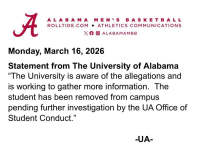
Statement from The University : " The student has been removed from the campus pending further investigation by the UA Office of Student Conduct"

Pete Thamel reporting this as well.Statement from The University : " The student has been removed from the campus pending further investigation by the UA Office of Student Conduct"
The way you phrased that it seems like an insult. Having fun shouldn’t qualify you as acting like a “child”. Agree he could show more leadership but he is a more reserved type of character. Not going to compare a guy of 4 years vs only 2 leadership wise though. I have seen him talking in huddles and to players on the court whether pumping up or whatever in stoppage times. But again overall agree he could be a more vocal dominant leader.I would turn this question around. What have you seen out of Philon that looks like leadership on the floor or during games? He smiles a lot and plays the game with a lot of joy; that's why I said he has childlike quality to him. It's his demeanor. But I don't really see him instructing his teammates, pumping up his teammates when they're down, organizing them on offense or defense. In fact, if you read draft predictions, that's what they cite as a negative (even from anonymous scouts). He lacks organizational skills as a point guard. He can't or doesn't get his team organized well. Compare it to someone like Jaden Bradley. You can see a stark contrast in that regard. He controls the tempo offensively and makes sure his team is composed and running appropriate stuff in the right way for the time and score. He gets them organized defensively. But again, if you've seen anything to contradict that with Philon, let me know because I haven't seen it. I also think it's telling that when CNO or teammates are asked about leaders on the team, his name is never mentioned that I've seen.

How did they not know? I don’t know how anyone can get that smell off of them.or definitely should be. Felony charge.
This explains a lot about our roller coaster play...IMHO. What's the likelihood that none of his teammates knew anything about it? Now we have major trust issues. You've got a teammate doing this and you did nothing (that we know of).
If I'm an AD and my program is paying you coin, I'm implementing random drug tests with harsh penalties. Couldn't care less what is or isn't politically correct, "socially acceptable" or anything else. Guys who don't want to take the test go somewhere else? Good.
If he was dealing then it is a MUCH bigger issue. Even if somehow he pleads it down, he has to be tossed for being so stupid. I have zero empathy for this kind of moronic behavior.
Your approach just creates too many more opportunities for bad PR for doing the right thing...Looks like #3 is the salient point. A student charged with a felony can be suspended. Not that the student will be suspended. Afterward, the student can request a review. I'm guessing who or what body conducts the review would be spelled out in the detailed document.
Regardless, I think that's too weak.
I'd say the student will be suspended immediately. Then the student can ask the President for a review / exemption. Not a committee. Not a board. Not a bunch of Deans or a random jury consisting of representatives of an infinite number of "stakeholder groups." The President alone.
Then, should the Chairperson of the UA Board of Trustees choose to do so, he or she can countermand the President's decision. That would apply whether the President decides to suspend or not. Again, not the BoT as a whole....the Chair. Whatever he or she decides is final.
At that point, further appeal would be to the courts, not University governance.
The level of appeal is intentionally high because the level of the threat to innocent students, faculty and staff is likewise high. Extensive time writing policy in the banking world taught me that the higher the level of appeal, (1) the less often it tends to be used, and (2) when it is used, the grounds for appeal tend to be much more persuasive.
Also having spent a long time in the loan approval process, I also found that when an individual has to make a decision like this, they're a lot more considered than when they have the skirts of a group to hide behind. IOW, if it blows up they can't say, "I didn't decide.....the Committee did. I was just one vote."
This way, the President and the Chair of the BoT can consult with anybody they want. But theirs are the names on the line.

You stole my words!or definitely should be. Felony charge.
This explains a lot about our roller coaster play...IMHO. What's the likelihood that none of his teammates knew anything about it? Now we have major trust issues. You've got a teammate doing this and you did nothing (that we know of).
If I'm an AD and my program is paying you coin, I'm implementing random drug tests with harsh penalties. Couldn't care less what is or isn't politically correct, "socially acceptable" or anything else. Guys who don't want to take the test go somewhere else? Good.
If he was dealing then it is a MUCH bigger issue. Even if somehow he pleads it down, he has to be tossed for being so stupid. I have zero empathy for this kind of moronic behavior.

I wish people would quit using the term”he/she is just a kid”.
He’s what 20? He is no kid. He knew he was doing wrong and got caught. I hope he gets what he deserves.
He’s what 20? He is no kid. He knew he was doing wrong and got caught. I hope he gets what he deserves.


Trending content
-

-
-

-
 Thread 'Good luck dealing with a pandemic, depending on this administration...'
- TIDE-HSV
Replies: 8K -
-

-
-
Latest threads
-
 ESPN: Oklahoma LB Heinecke sues NCAA to play in '26
- Started by TideFans Reporter
- Replies: 0
-
 How About Some Love for Our 3 Seniors - Wrightsell, Mallette and Williamson???
- Started by BamaMoon
- Replies: 2
-
ESPN: What returning production looks like for the 2026 season
- Started by TideFans Reporter
- Replies: 0
-
 Alabama Overcomes Early Deficit, Wins 14-7 to Sweep No. 18 Florida
- Started by Diamond Tide
- Replies: 0
-

-