
Legalizing THC (DJ Hall thread)

For every person I know/knew who routinely smoked pot and was a total screw-up, I know at least one who was a perfectly well adjusted and productive individual, which includes professors, attorneys, C-level executives, very high grossing patent holders, authors, and journalists. A couple of incredibly productive Dutch folks I know, who live in Amsterdam, smoke every single day after work and run a million dollar business in 6 languages. Anecdotal evidence gets us nowhere.

I think the idea that weed somehow turns a totally normal individual into a goodfornothin' is silly. The fact is, many people here in America who would routinely indulge in an illegal product such as weed are already goodfornothin'.

Weed is a gateway drug for people predisposed to engage in illicit activity to get their rocks off. Your average joe doesn't tend to have a problem with it, and it's not your average joe that really does it these days, as weed is illegal. As discussed above, the average folks that have/are done it, are still just that - average folks.

Considering the public policy side of it, legalizing marijuana makes a great deal of sense. Here is a paper from the Cato institute on the implications of legalization. Here is one that I like from the esteemed RAND Institute. Illegal pot growers would be out of business if it were legalized, as pot prices would likely plummet upwards of 80 percent and make the unlicensed production not worth it.

There are many papers out there pointing out the good sense of legalization:
Legalizing the production and distribution of marijuana in California could cut the price of the drug by as much as 80 percent and increase consumption, according to a new study by the nonprofit RAND Corporation that examines many issues raised by proposals to legalize marijuana in the state.
While the state Board of Equalization has estimated taxing legal marijuana could raise more than $1 billion in revenue, the RAND study cautions that any potential revenue could be dramatically higher or lower based on a number of factors, including the level of taxation, the amount of tax evasion and the response by the federal government.
 
For every person I know/knew who routinely smoked pot and was a total screw-up, I know at least one who was a perfectly well adjusted and productive individual, which includes professors, attorneys, C-level executives, very high grossing patent holders, authors, and journalists. A couple of incredibly productive Dutch folks I know, who live in Amsterdam, smoke every single day after work and run a million dollar business in 6 languages. Anecdotal evidence gets us nowhere.

I only cited my experiences to inform where I am coming from. I continue to believe that there are those that can function. However, I continue to maintain that I have yet to know someone well who continually used pot and was never affected negatively. I dare say that all who have been around enough people that continually use pot know of someone that appears to be unaffected. While anecdotal evidence may get us nowhere in convincing each other, it is what most people base their beliefs on. I would include you and me both in this. Policy makers who dismiss or ignore it do so at the risk of creating policy that will not be supported.

I think the idea that weed somehow turns a totally normal individual into a goodfornothin' is silly. The fact is, many people here in America who would routinely indulge in an illegal product such as weed are already goodfornothin'.

I am not sure how many ways I disagree with this.

I find it hard to believe that you have not had an opportunity to see this happen. I guess it is possible.

In my opinion this statement is at complete odds with your first statement.

I can't think of anyone I would categorize as 'goodfornothin' simply because they routinely indulge in using weed, but I have seen a lot of people throw a way a lot (or everything) just to continue using.

Weed is a gateway drug for people predisposed to engage in illicit activity to get their rocks off. Your average joe doesn't tend to have a problem with it, and it's not your average joes that really does it these days, as weed is illegal. As discussed above, the average folks that have/are done it, are still just that - average folks.

In my opinion the first statement is way too general. I do not deny that there are people that are predisposed based on a lot of factors, but to place everyone (or even most people) that have come to a point where their weed use has led to other more dangerous drug use in this category is misguided.

Which way is it? Do average folks do it or not? Are the C-level executives or goodfornuthin's?

Considering the public policy side of it, legalizing marijuana makes a great deal of sense. Here is a paper from the Cato institute on the implications of legalization. Here is one that I like from the esteemed RAND Institute. Illegal pot growers would be out of business if it were legalized, as pot prices would likely plummet upwards of 80 percent and make the unlicensed production not worth it.

There are a whole lot of "it depends" in both of those studies. There is no way that illegal pot growers would be out of business if it were legalized. Any taxation at all would make that impossible. I find it hard to believe that the drug cartels would willingly submit to licensing and taxation of their product.

One this is clear and obvious. It would increase use. Those who do want to, but do not because of the legality would start.

Both of these papers and practically every study anyone has pointed me to indicate from the beginning that they are proposing this for tax policy. If there is anything government wants more of it is tax income. No doubt more money would flow into the government coffers. Examples where taxing something has reduced its price are rare with the possible exception of high enough tax levels reducing growth to a point where deflation occurs.
 
Last edited:
If you haven't, do some research to find out how they initially developed the modern 'drug laws' in the early 20th century - they knew it was unconstitutional to ban the drugs directly (primarily opium and its derivatives, at the time), so they side-stepped the Constitution by making it a taxable/licensable (read: controllable) substance.

Even today it's about not having the proper 'license'...

I take your word for it.

I am not one for trampling the constitution and in general strong federal governments scare me.

That said, do you believe any measure for legalization on this or any other basis would remove licensing of producers and taxation of both the producers and the users?
 
That said, do you believe any measure for legalization on this or any other basis would remove licensing of producers and taxation of both the producers and the users?
Oh, no, and rightfully so - taxation is a foundational way by which most any modern government works. In fact, instead of spending untold billions annually to fight a war we can never win, we'd actually make billions in tax dollars, much like cigarettes, for example.

My earlier point regarding taxation/licensing is that the fedgov used that, in essence, to make certain drugs illegal. You had to pay a tax to legally buy it, and only certain people were allowed to sell it (think modern beer or alcohol licenses). It wasn't about taxing the use for revenue, it was purely a method of controlling what people had legal access to.

Funny how people (rhetorical here, not you specifically) don't seem to understand that humans will always do drugs - there isn't a known civilization in history of mankind (that I'm aware of) that didn't have some sort of mind-altering drug in use. I'm not saying everyone does it, per se, but a vast majority of people do, whether it's something mild like caffeine or something more powerful like an opiate. The reality is the demand for drugs will always exist and even after the massive failure of alcohol prohibition in the early 20th century our fedgov is unwilling to remove the blinders to see that not only is their side-stepping of the Constitution immoral, but it simply won't work. Ever.
 
This is valid point. My use of the term Black Market is not correct. I believed the term to be used just for trafficing in goods that were legal, but taxed at such a rate that a remaining underground economy is a certainty.

I do believe that if legalized this would occur. Crime would not change, the tax rate would be so high that we would be back the days of moonshiners and revenuers. Again I could be wrong, but believe there is strong evidence to the contrary.

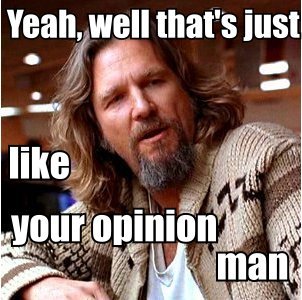
your_opinion.jpg

Lets just say they did legalize it. And lets say cigarettes are the model. Even if a 'pack of joints' costs twice as much as a pack of cigarettes it would still cut the legs out from under most of the illegal operations out there. IMO, the fact that shipping marijuana across the border is such a cash cow for the Mexican cartels should be reason enough to try a different approach.
 
This is a statement I keep hearing, without any substantiation, phrased in such a way to remove all personal responsibility, and without any advice as to what that something else should be...
Millions have gone to prison in this "war on drugs", and drug use has not diminished. New drugs are introduced into this thriving market every day. Are you seriously asking me to prove that?
When you use the phrase try something else, you need to specify what, and really think through intended and unintended consequences of your advice.
I am not trying to sway anyone. I offer no advice. I am just pointing out a policy that has (IMO) failed miserably.

This is the internet. We are not solving problems here - just discussing them.

:cool:
 
I would be very interested in how you make the case for point 1.

North Carolina:
July 28th, 1788, Mr. MacLaine said, “The powers of Congress are limited and enumerated. We say we have given them those powers, but we do not say we have given them more. We retain all those rights which we have not given away to the general government. … The Congress cannot assume any other powers than those expressly given them, without a palpable violation of the Constitution. [Elliot’s Debates, vol. IV, pg. 140-1]

Mr. Iredell (July 29th 1788) said “If the Congress should claim any power not given them, it would be as bare a usurpation as making a king in America. If this Constitution be adopted, it must be presumed the instrument will be in the hands of every man in America, to see whether authority be usurped; and any person by inspecting it may see if the power claimed be enumerated. If it be not, he will know it to be a usurpation.” (Elliot’s Debates, vol. IV, pg. 172)

Iredell (July 30th, 1788,) “The powers of the government are particularly enumerated and defined: they can claim no others but such as are so enumerated. In my opinion, they are excluded as much from the exercise of any other authority as they could be by the strongest negative clause that could be framed.” (Elliot’s Debates, vol. IV, pp. 219-220).
In her instrument of ratification, NC declared, “that each state in the union shall, respectively, retain every power, jurisdiction and right, which is not by this constitution delegated to the Congress of the United States, or to the departments of the Federal Government.

Pennsylvania:
James Wilson, 6 Oct 1787: “When the people established the powers of legislation under their separate governments, they invested their representatives with every right and authority which they did not in explicit terms reserve; and therefore upon every question respecting the jurisdiction of the House of Assembly, if the frame of government is silent, the jurisdiction is efficient and complete. But in delegating federal powers, another criterion was necessarily introduced, and the congressional power is to be collected, not from tacit implication, but from the positive grant expressed in the instrument of the union. Hence, it is evident, that in the former case everything which is not reserved is given; but in the latter the reverse of the proposition prevails, and everything which is not given is reserved.”

South Carolina:
Charles Cotesworth Pinckney, 18 January 1788: “The general government has no powers but what are expressly granted to it; … by delegating express powers, we certainly reserve to ourselves every power and right not mentioned in the Constitution.”
In her instrument of ratification, SC declared, “this Convention doth also declare that no Section or paragraph of the said Constitution warrants a Construction that the states do not retain every power not expressly relinquished by them and vested in the General Government of the Union.”

Massachusetts:
1 Feb 1787, Mass. Convention, John Adams said, “I have long considered the watchfulness of the people over the conduct of their rulers the strongest guard against the encroachments of power; and I hope the people of this country will always be thus watchful.” The Massachusetts Convention later added its understanding of the powers of the general government: “that it be explicitly declared, that all powers not expressly delegated by the aforesaid Constitution are reserved to the several states, to be by them exercised.”1

Virginia:
June 6th, 1788, Mr. James Madison said, “the powers of the federal government are enumerated; it can only operate in certain cases; it has legislative powers on defined and limited objects, beyond which it cannot extend its jurisdiction.”

Mr. John Marshall (June 20th, 1788): “…Has the government of the United States power to make laws on every subject? … Can they go beyond the delegated powers? If they were to make a law not warranted by any of the powers enumerated, it would be considered by the judges as an infringement of the Constitution which they are to guard.”

June 21, 1788, Gov. Edmund Randolph said “If I did believe, with the honorable gentleman (Mr. Henry), that all power not expressly retained was given up by the people, I would detest this government. But I never thought so, nor do I now. If, in the ratification, we put words to this purpose, "and that all authority not given is retained by the people, and may be resumed when perverted to their oppression; and that no right can be cancelled, abridged, or restrained, by the Congress, or any officer of the United States,"— I say, if we do this, I conceive that, as this style of ratification would manifest the principles on which Virginia adopted it, we should be at liberty to consider as a violation of the Constitution every exercise of a power not expressly delegated therein. I see no objection to this. It is demonstrably clear to me that rights not given are retained.”
June 24th, 1788, Mr. James Madison said, “The powers granted by the proposed Constitution are the gift of the people, and may be resumed by them when perverted to their oppression, and every power not granted thereby remains with the people, and at their will. It adds, likewise, that no right, of any denomination, can be cancelled, abridged, restrained, or modified, by the general government, or any of its officers, except in those instances in which power is given by the Constitution for these purposes. There cannot be a more positive and unequivocal declaration of the principle of the adoption – that every thing not granted is reserved. … Can the general government exercise any power not delegated? … The delegation alone warrants the exercise of any power.”

In her instrument of ratification, Virginia declared, “the powers granted under the Constitution being derived from the People of the United States may be resumed by them whensoever the same shall be perverted to their injury or oppression and that every power not granted thereby remains with them and at their will.”


Bottom line: The power to regulate drugs is nowhere delegated to the Federal government, therefore, it is prohibited for the Federal government to pass a law on the subject.
Note that this is not necessarily an argument in favor of absolute permissiveness in relation to drugs. The state government, subject to the provisions of their respective state constitutions, have the power to regulate drug usage.
 
Last edited:
...Bottom line: The power to regulate drugs is nowhere delegated to the Federal government, therefore, it is prohibited for the Federal government to pass a law on the subject.
Note that this is not necessarily an argument in favor of absolute permissiveness in relation to drugs. The state government, subject to the provisions of their respective state constitutions, have the power to regulate drug usage.
Respectfully clipped the post, but that was a pleasure to read. My thanks.

Off topic - I am no libertarian, but the federal government seems to have decided that the states simply cannot be trusted to govern themselves. I am not sure when it started, maybe with the Civil War, but it is a part of the fabric of America as we have come to know it. Long gone are the days when "limited government" was a real possibility. Not sure where we go from here, but evidence that our founding fathers meant for us to be in a different place today will hold little sway. Our Constitution remains one of the most important documents even written, but our government ignores it far more frequently than it observes it. I would argue that our government has become too powerful - so powerful that it can get away with ignoring the Constitution. We are powerless to stop them.
 
Bottom line: The power to regulate drugs is nowhere delegated to the Federal government, therefore, it is prohibited for the Federal government to pass a law on the subject.
Note that this is not necessarily an argument in favor of absolute permissiveness in relation to drugs. The state government, subject to the provisions of their respective state constitutions, have the power to regulate drug usage.

people talk about how the government is missing an opportunity for revenue by not legalizing and taxing weed. I wonder if those people ar referring to the Federal or state/local? Because if the Fed has no Constitutional right to criminalize it, surely they have no right to tax it.
 
people talk about how the government is missing an opportunity for revenue by not legalizing and taxing weed. I wonder if those people ar referring to the Federal or state/local? Because if the Fed has no Constitutional right to criminalize it, surely they have no right to tax it.
Completely false. The interstate commerce clause would grant rights to anything that crossed state lines (though the FedGov even applies it to intrastate sales nowadays, as wrong as that is).

But even if it was just local/state government taxation, it would be a huge upswing once you stop all these asinine prison terms for folks doing something they should be able to do as long as they don't impinge upon another's rights or endanger others.
 
Last edited:
I would argue that our government has become too powerful - so powerful that it can get away with ignoring the Constitution.
Sounds like an eloquent argument for the people of the states to declare that we have made a bad mistake and doing away with that mistake.
We are powerless to stop them.
Not entirely. I read a nineteenth century commentator put forward an idea that would not involve violent overthrow at all. If a majority of the members of either house of congress would just stay away from Congress, that house would lack a quorum, could transact no business, could adopt no laws, could not pass a budget (Article 1, Section 5). Without a budget, it is difficult to see how the Federal government could have any substantive existence. Maybe one year in limbo would suffice to convince the other Federal officials to stay in they dadgum box.
 
what? the Federal drug policy creates demand? It actually MAKES people do drugs?

No, but it has created a sub-culture that is fed by drugs. Drugs are the staple in the "diet" of millions of Americans. Perhaps of greater concern is the number of lives destroyed by the war on drugs.

Drug Offenders Crowd the Nation’s Prisons and Jails. At midyear 1996, there were 93,167 inmates in federal prisons, 1,019,281 in state prisons, and 518,492 in jails. In 1994, 59.5 percent of federal prisoners were drug offenders as were 22.3 percent of the inmates in state prisons. The increase in drug offenders accounts for nearly three quarters of the total growth in federal prison inmates since 1980. According to a 1991 joint survey of federal and state prison inmates, an estimated 10 percent of federal prisoners and 17 percent of state prisoners reported committing offenses in order to pay for drugs.

Think about that - combined, 70% of federal prisoners and 40% of state prisoners are incarcerated because of drugs.

I believe that drug use, overall, is actually down in America since the launch of the war on drugs - but we have sacrificed an entire subset of our society to reach that goal. And now, with drug use back on the up-swing, the long term failures may very well outweigh the short term successes. These "sacrificed" people and their families are still a part of America. What effect will they have on our future?

Again, I don't pretend to have the answers, but I see a problem.
 
Sounds like an eloquent argument for the people of the states to declare that we have made a bad mistake and doing away with that mistake.
Not entirely. I read a nineteenth century commentator put forward an idea that would not involve violent overthrow at all. If a majority of the members of either house of congress would just stay away from Congress, that house would lack a quorum, could transact no business, could adopt no laws, could not pass a budget (Article 1, Section 5). Without a budget, it is difficult to see how the Federal government could have any substantive existence. Maybe one year in limbo would suffice to convince the other Federal officials to stay in they dadgum box.
An interesting idea. The problem - our congressmen are a part of the federal government and have no interest in reducing their own power. I do not see a solution that involves use of government officials to limit government power as realistic. It is up to the people, and too many of the people rely on the government. We have probably passed the point of no return.
 
Completely false. The interstate commerce clause would grant rights to anything that crossed state lines (though the FedGov even applies it to intrastate sales nowadays, as wrong as that is).

But even if it was just local/state government taxation, it would be a huge upswing once you stop all these asinine prison terms for folks doing something they should be able to do as long as they don't impinge upon another's rights or endanger others.

which part is false? I am asking questions, although I see I did leave a '?' off the last sentence.
 
An interesting idea. The problem - our congressmen are a part of the federal government and have no interest in reducing their own power. I do not see a solution that involves use of government officials to limit government power as realistic. It is up to the people, and too many of the people rely on the government. We have probably passed the point of no return.
I hear what you are saying.
My idea would be premised on candidates pledged to a platform along the lines of, "Elect me, and I promise I will avoid Washington DC to the best of my abilities. I will hide from the House Sergeant-at-Arms for the entire two years of my tenure."
You are right, the current political class cannot be trusted to rein in the Federal government. It would take another type of candidate to enact the above idea. A guy can dream, though.
 
which part is false? I am asking questions, although I see I did leave a '?' off the last sentence.
Ah, well, yah - the last sentence being a question changes it. The statement "Because if the Fed has no Constitutional right to criminalize it, surely they have no right to tax it" is what I was referring to, they absolutely can tax it - that's how they side-stepped the Constitution in order to regulate it in the first place!
 
No, but it has created a sub-culture that is fed by drugs. Drugs are the staple in the "diet" of millions of Americans. Perhaps of greater concern is the number of lives destroyed by the war on drugs.

Drug Offenders Crowd the Nation’s Prisons and Jails. At midyear 1996, there were 93,167 inmates in federal prisons, 1,019,281 in state prisons, and 518,492 in jails. In 1994, 59.5 percent of federal prisoners were drug offenders as were 22.3 percent of the inmates in state prisons. The increase in drug offenders accounts for nearly three quarters of the total growth in federal prison inmates since 1980. According to a 1991 joint survey of federal and state prison inmates, an estimated 10 percent of federal prisoners and 17 percent of state prisoners reported committing offenses in order to pay for drugs.

Think about that - combined, 70% of federal prisoners and 40% of state prisoners are incarcerated because of drugs.

I believe that drug use, overall, is actually down in America since the launch of the war on drugs - but we have sacrificed an entire subset of our society to reach that goal. And now, with drug use back on the up-swing, the long term failures may very well outweigh the short term successes. These "sacrificed" people and their families are still a part of America. What effect will they have on our future?

Again, I don't pretend to have the answers, but I see a problem.

the subculture created itself. I don't know the exact reason why weed is illegal, but it is. So those who choose to break the law are making a conscious choice...they aren't being forced to grow, sell, or smoke it.
 
the subculture created itself. I don't know the exact reason why weed is illegal, but it is. So those who choose to break the law are making a conscious choice...they aren't being forced to grow, sell, or smoke it.

You see no cause/effect? :conf3:
 

New Posts

Advertisement

Trending content

Advertisement

Latest threads