Politics and Religion

Politics and religion, while different domains, do not exist in vacuums, and our political order is built on the understanding that religion is a force for good in a free society.


Really? Whose religion? And I guess it all depends on what one means by a "force for good" and a "free society."
 
  • Like
Reactions: 92tide
Politics and religion, while different domains, do not exist in vacuums, and our political order is built on the understanding that religion is a force for good in a free society.


Really? Whose religion? And I guess it all depends on what one means by a "force for good" and a "free society."
I caught that, too and while it seems subjective, there’s no question about the contributions of the church to western civilization.
 
  • Like
Reactions: Huckleberry
Politics and religion, while different domains, do not exist in vacuums, and our political order is built on the understanding that religion is a force for good in a free society.


Really? Whose religion? And I guess it all depends on what one means by a "force for good" and a "free society."
soothing bromides like this always leave out pesky nuance and context
 
The internixing of politics and religious is quite a dangerous cocktail. Both include sets of beliefs involving articles of faith and the suspension of critical analysis. There is a reason society has ruled that it is best not to discuss politics or religion in polite company.
The separation of the two is not normal for human society.
In ancient China, Confucianism was the state-mandated religion. The Aztecs embraced an official state religion. Arab-muslim society unified the state and Islam. Eastern Orthodox civilization invented what it called caesaropapism, a close marriage between the head of state and the head of church. Only Western Christendom, due to the fracturing of political authority after the fall of the Western Empire, arrived at the separation of church and state (starting with Saint Ambrose forbidding the Emperor from entering the cathedral and receiving communion.
View attachment 56615
After the sixteenth century Wars of Religion, the solution was Cujus regio, eius religio (Whose kingdom, his religion or everyone adopts the religion of their ruler). After the massive carnage of the 30 Years' War, Western Christians for the most part agreed to leave religious questions between each individual and God. Not everyone embraces this, but I would accept it as a standard of Western civilization, especially an American one.
Other civilizations did not embrace this, especially Islam.
If the United States continues to import muslim immigrants at the rate of 200,000/year, Americans will eventually see first-hand how "separation of church and state" is not an Islamic tenet. It will be jettisoned as soon as the political power to do so develops.

Self-governance was/is considered to be a delusion. George III, when told of our plan to form a Repubic with a Constitution was said to have asked Franklin "Have you gone mad? You're educated men. You know our history. You expect men, when times are bad, to respect a piece of paper called a 'Constitution'? A Constitution they can't read? And if they could, couldn't understand? When times are lean, these primitives will only respect and believe in God and a King who comes from God. This is why I have to marry my cousin and suffer from free-bleeding and 'Hapsburg Jaw". It's the only way crops can be planted and harvested and we don't have war and famine for generations at a time and lose all the inherited knowledge and technology of our forefathers. Within a few years you'll come crawling back begging me to Rule you."

He was correct, of course. About France. They're on their, what, Fifth Republic, now? With a couple of Monarchies in between? We've had a good run here in the U.S. but the Jury is still out on us. Most adults are still superstitious, overgrown five-year-olds emotionally and mentally. The populace still can't read and has no understanding of our civic governance. This now includes even our Senators!

We're still putting our teeth under our pillow.
 
Self-governance was/is considered to be a delusion. George III, when told of our plan to form a Repubic with a Constitution was said to have asked Franklin "Have you gone mad? You're educated men. You know our history. You expect men, when times are bad, to respect a piece of paper called a 'Constitution'? A Constitution they can't read? And if they could, couldn't understand? When times are lean, these primitives will only respect and believe in God and a King who comes from God. This is why I have to marry my cousin and suffer from free-bleeding and 'Hapsburg Jaw". It's the only way crops can be planted and harvested and we don't have war and famine for generations at a time and lose all the inherited knowledge and technology of our forefathers. Within a few years you'll come crawling back begging me to Rule you."

He was correct, of course. About France. They're on their, what, Fifth Republic, now? With a couple of Monarchies in between? We've had a good run here in the U.S. but the Jury is still out on us. Most adults are still superstitious, overgrown five-year-olds emotionally and mentally. The populace still can't read and has no understanding of our civic governance. This now includes even our Senators!

We're still putting our teeth under our pillow.
Despite being very pessimistic, I do not disagree on any particular.
Having read a bit of what they said, I believe the Founders intended that writing the Constitution down would help subsequent politicians stay true to it later. Britains (still) has no written Constitution, just an accretion of precedents (and a couple of significant waypoints like Magna Carta and the 1689 Bill of Rights).

As for respecting the Constitution, the document does not enforce itself, so the Founders did place certain checks for the people to force their servant back into its proper place. The people almost came to blows over that once and did come to blows once. We now call those people traitors, so maybe George III was right.
 
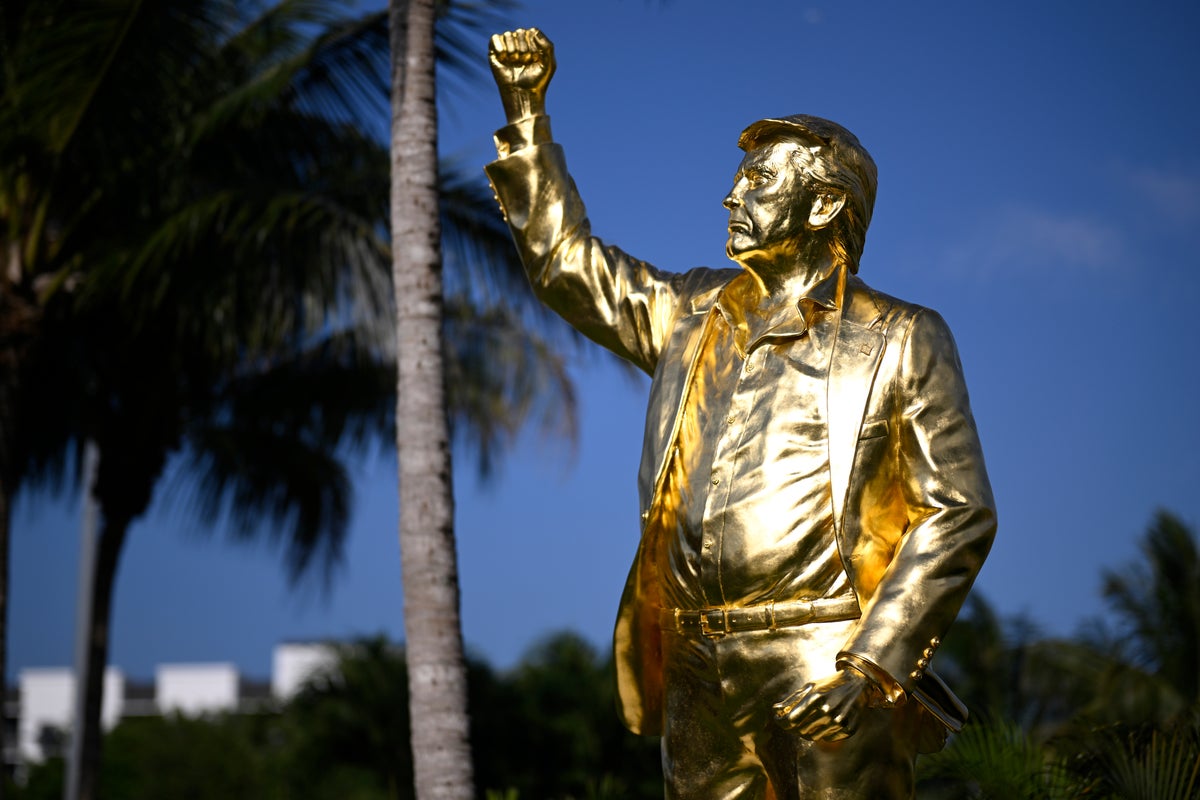
i guess this sort of fits here


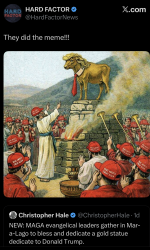
“Today at Trump National Doral Miami, we witnessed an unforgettable moment,” Burns wrote on social media before emphasizing that the gilded effigy was not a false idol.

“Let me be clear: this is not a golden calf,” he said. “This statue is a celebration of life. It is a symbol of resilience, freedom, patriotism, strength, and the will power to keep fighting for the future of America.”
 
  • Wow
Reactions: UAH and spidermayin
i guess this sort of fits here


“Today at Trump National Doral Miami, we witnessed an unforgettable moment,” Burns wrote on social media before emphasizing that the gilded effigy was not a false idol.

“Let me be clear: this is not a golden calf,” he said. “This statue is a celebration of life. It is a symbol of resilience, freedom, patriotism, strength, and the will power to keep fighting for the future of America.”
1778350028822.png
 
https://x.com/SecWar
Secretary of War Pete Hegseth:
A nation worth fighting for is a nation worth praying for. Rededicate 250 on Sunday, May 17, will bring patriots from every state together on the National Mall under one flag and one God.

RSVP for Sunday, May 17, in Washington, DC: http://f250.digital/pray


The problem isn’t prayer. Americans can pray for the country all they want.

The problem is a cabinet secretary using the weight of his office to promote an event framed as “rededicating” the United States to God. That’s not just religious liberty. That’s government power being used to push a religious message.

And “one flag and one God” is not neutral patriotic language. It suggests that real national unity requires religious unity, and that full American belonging depends on accepting a theological claim.

That is exactly where the government should not be. The Constitution protects your right to worship. It does not give federal officials license to imply that real Americans stand under one God.
 
  • Haha
  • Thank You
Reactions: UAH and 92tide
https://x.com/SecWar
Secretary of War Pete Hegseth:
A nation worth fighting for is a nation worth praying for. Rededicate 250 on Sunday, May 17, will bring patriots from every state together on the National Mall under one flag and one God.

RSVP for Sunday, May 17, in Washington, DC: http://f250.digital/pray


The problem isn’t prayer. Americans can pray for the country all they want.

The problem is a cabinet secretary using the weight of his office to promote an event framed as “rededicating” the United States to God. That’s not just religious liberty. That’s government power being used to push a religious message.

And “one flag and one God” is not neutral patriotic language. It suggests that real national unity requires religious unity, and that full American belonging depends on accepting a theological claim.

That is exactly where the government should not be. The Constitution protects your right to worship. It does not give federal officials license to imply that real Americans stand under one God.

It is a tenant of Christian Dominionism / Nationalism that we must become a religiously organized military society and take over the world for the Kingdom to come. Hegseth and a number of others in the Trump admin believe they are the chosen ones and can make this happen.
 
  • Thank You
Reactions: UAH and 92tide
https://x.com/SecWar
Secretary of War Pete Hegseth:
A nation worth fighting for is a nation worth praying for. Rededicate 250 on Sunday, May 17, will bring patriots from every state together on the National Mall under one flag and one God.

RSVP for Sunday, May 17, in Washington, DC: http://f250.digital/pray


The problem isn’t prayer. Americans can pray for the country all they want.

The problem is a cabinet secretary using the weight of his office to promote an event framed as “rededicating” the United States to God. That’s not just religious liberty. That’s government power being used to push a religious message.

And “one flag and one God” is not neutral patriotic language. It suggests that real national unity requires religious unity, and that full American belonging depends on accepting a theological claim.

That is exactly where the government should not be. The Constitution protects your right to worship. It does not give federal officials license to imply that real Americans stand under one God.
our gender affirming secretary of defense keeps blowing poe's law out of the water
 
It is a tenant of Christian Dominionism / Nationalism that we must become a religiously organized military society and take over the world for the Kingdom to come. Hegseth and a number of others in the Trump admin believe they are the chosen ones and can make this happen.
IMO, the evidence suggests they are more loyal to Zionism than they are Christian Nationalism. Not that I find either option appealing, mind you.
 
  • Like
Reactions: UAH
I think the concepts intermingle in the minds of those who are delusional enough to think they are a good idea.
Some yes, some no. Theology can be all over the map. Still, it's clear to me which one has the greater influence on our nation, particularly as it relates to foreign policy.
 

Agriculture employees sue Rollins over ‘escalating’ religious messaging​

Department of Agriculture employees are suing Agriculture Secretary Brooke Rollins over a series of emails she sent to staff, arguing that the “increasingly proselytizing” messages crossed a line and violated the First Amendment.

The new lawsuit, filed in the U.S. District Court for the Northern District of California, comes in response to an Easter message Rollins sent to USDA employees in April. Plaintiffs called Rollins’ message “unconstitutionally coercive,” as it sought “to impose her brand of Christianity on the agency’s 100,000 employees.”
 
  • Like
Reactions: 92tide
The founders were far and away from the beliefs of modern evangelicals. They were strongly influenced by Deism and the Enlightenment's interest in rationalism.

It is a very interesting topic indeed...


The belief that most Founding Fathers were deists is a subject of historical debate, with evidence suggesting a complex mix of religious views rather than a consensus on Deism. While influential founders like Thomas Jefferson and Benjamin Franklin exhibited deistic beliefs, many others were practitioners of Christianity or a blend of Christian and Enlightenment-influenced beliefs. [1, 2, 3, 4, 5]
  • Influence of Deism: Many founders were influenced by Deism, which emphasizes reason over dogma and the separation of church and state.
  • Key Deists: Jefferson, Franklin, and Thomas Paine are often cited as holding, or at least moving toward, deist views, including skepticism about miracles and the divinity of Jesus.
  • Religious Affiliations: Most Founders were formally affiliated with Christian churches, and some historians argue that the majority did not subscribe to the full tenets of Deism.
  • Theistic Rationalists: Historians like David L. Holmes suggest many founders, including George Washington, were "theistic rationalists"—a position between orthodox Christianity and deism.
  • Mixed Beliefs: Some founders maintained conventional Christian faith, while others adopted Unitarian or deist viewpoints while still operating within a Christian context. [1, 2, 3, 4, 5]
While some founders favored deistic thought, it is more accurate to say that many were influenced by Enlightenment-era rationalism rather than formally identifying as deists. [1, 2, 3]

No, the Founding Fathers were generally very different from modern evangelicals in their theology, style of worship, and view of the Bible.
While a few orthodox Christian founders shared a belief in personal salvation, the overall intellectual culture of the leadership era clashed fundamentally with modern evangelicalism.

Major Differences
  • The Authority of the Bible: Modern evangelicals generally believe the Bible is literal truth and without error. Most prominent founders viewed the Bible through Enlightenment rationalism, treating it as a great moral guide rather than a literal, divine roadmap.
  • Reason Over Emotion: Modern evangelicalism emphasizes an emotional, personal relationship with Jesus Christ and "born-again" experiences. The founders valued reason, self-restraint, and intellectual logic far above religious emotion or enthusiasm.
  • The Divinity of Jesus: Central to modern evangelicalism is the belief that Jesus is God and rose from the dead. Key founders like Thomas Jefferson, Benjamin Franklin, and John Adams explicitly rejected the Trinity and the miracles of Jesus.
  • Separation of Church and State: Evangelicals often advocate for Christian values to directly shape public law and government. The founders—even the deeply religious ones—were fiercely committed to preventing any single religious group from controlling the state.

Minor Similarities
  • Public Morality: Both groups agree that a society cannot stay free or stable without a strong foundation of personal morality and virtue.
  • The Orthodox Minority: A few founders, like Patrick Henry, Samuel Adams, and John Jay, held traditional, orthodox Christian beliefs that align more closely with modern evangelical theology.
 
Advertisement

Trending content

Advertisement

Latest threads