
75th anniversary of D-Day...

April 20, 1945: On the western front, elements from British 2nd Army are attacking around Bremen. US 9th Army continues preparing positions along the Elbe River and eliminating bypassed pockets in the rear while US 1st Army attacks Bitterfeld and Dessau and eliminates organized resistance in the Harz Mountains pocket. Elements of Patton’s US 3rd Army attack toward Regensburg while other troops discover the German weapons and munitions storage at Grafenwohr. Further south, US 7th Army captures Nuremberg and pushes southward. Instructed to sacrifice everything for speed the French 5th Armored Division and Spahi reconnaissance regiment enthusiastically overcame the fanatical resistance from German SS units to enter the western suburbs of Stuttgart, Germany. The tanks move so fast that it will not be until the following day that their supporting infantry (Moroccan and Algerian Tiralleurs) are able to catch up - but they had beaten the Americans to the southwest German city.

Between 13,500 and 15,000 prisoners are transferred from Buchenwald and Gross-Rosen sub-camps to the Theresienstadt Concentration Camp in occupied Czechoslovakia over the following 20 days.

In Berlin, Hitler celebrates his 56th (and last) birthday in his bunker in Berlin with Goering, Himmler, Goebbels, Speer, Ribbentrop, Bormann, and other top military leaders. Preparations are made to evacuate Hitler and his staff from the bunker to Obersalzberg for a last stand in the Alpine Redoubt, but Hitler refuses to leave the bunker. Goering and Himmler depart Hitler's bunker for the last time. Doenitz rejects a Japanese invitation to transfer remaining German warships to Asia and continue warfare against the Allies.

Over Nazi Germany, US 8th Air Force attacks targets around Berlin with 755 bombers while US 15th Air Force fighters attack transportation targets. RAF Bomber Command sends 100 aircraft to attack Regensburg during the day, 76 aircraft to attack Berlin overnight (in what will be the RAF’s last mission against the German capital), and 36 aircraft to attack Schleissheim airfield overnight.

On the eastern from, in northern Germany, forces of the Soviet 2nd Belorussian Front join in the advance from the Oder River line, on a 30-mile frontage south-west of Stettin, opening an offensive against the German 3rd Panzer Army. To the south, German resistance on the Oder and Neisse river lines has been eliminated. Troops of the 1st Belorussian Front capture Protzel and Bernau and begins heaping artillery fire on the eastern suburbs of Berlin. Units of 1st Ukrainian Fronts cross over the Spree River, capturing Barut and Juterbog and continuing attacking toward Berlin.

Joseph Stalin orders the Soviet Stavka to influence troops to be more humane toward the civilians of conquered German territories in order to ease the future occupation.

In Italy, US 5th Army breaks through the German defensive lines and reaches the Po River Valley north of Bologna, Italy. British 8th Army advances toward Bologna and crosses the Idice River. US 12th Air Force aircraft support US 5th Army operations and attack targets throughout northern Italy, while US 15th Air Force attacks targets throughout northern Italy with more than 700 bombers.

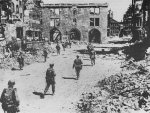
Pictured: A Bren gunner watches for enemy movement on the banks of the Elbe River, at Hoopte near Winsen, April 20, 1945.; US soldiers of the 3rd Infantry Division walk through a devastated Nuremberg, April 20, 1945.; An American soldier observed the destruction of an industrial town near Nuremberg, Germany, April 20, 1945.; An oil tank explosion at Deggendorf harbor, Germany after an aerial bombardment by A-20 Havoc aircraft of US 426th Bomb Group, April 20, 1945.; Soviet BM-13 Katyusha rocket launchers firing on Berlin, Germany, April 1945.

0420a.jpg0420b.jpg0420c.jpg0420d.jpg0420e.jpg
 
That would have been quite an achievement if they had made it.
Even submarines would have had a difficult time making that trip.
At that point, the criminal military clique was still firmly in control in Tokyo.
That would have been quite an achievement if they had made it.
Even submarines would have had a difficult time making that trip.
They would have been of no use by the time they arrived...
 
They would have been of no use by the time they arrived...
I'm not sure how committed Dönitz (or any German sailor) was to fighting on in the Pacific if Germany was completely occupied.
To what end? Dönitz was probably too pragmatic for such silliness, even if it were physically possible.
 
  • Like
Reactions: TIDE-HSV
April 20, 1945: ... Joseph Stalin orders the Soviet Stavka to influence troops to be more humane toward the civilians of conquered German territories in order to ease the future occupation.
I'm not sure how much this trickled down the the average Ivan toting a PPSh-41 through central Germany (many of them were behaving atrociously) and how much of this direction was window dressing designed to appease his western Allies.
 
Last edited:
April 21, 1945: On the western front, British 2nd Army attacks around Bremen. US 9th Army continues preparing positions along the Elbe River and eliminating bypassed pockets in the rear while US 1st Army attacks into Dessau, clearing along Elbe River and Mulde River, and mops up bypassed pockets. Having disbanded his Army Group B headquarters and evaded capture in the Ruhr pocket, Field Marshal Model commits suicide. US 3rd Army attacks Rossbach, Gottmannsgruen, Weiden, Mitterteich, Falkenberg, Wildenreuth, Schirnding, Waldsassen, and Neumarkt while further south US 7th Army advances south toward the Danube River on a broad front and the French 1st Army captures Stuttgart and reaches Swiss border at Schaffhausen.

About 300 German civilians from Gardelegen, Saxony, Germany are ordered by the US Army commander in the region to bury the 1,016 political and military prisoners who had been murdered by German SS and Luftwaffe troops in the Gardelegen Massacre the week before.

Over Germany, US 8th Air Force attacks Munich with 111 bombers and Ingolstadt with 212 bombers. US 15th Air Force aircraft attack transportation targets. RAF Bomber Command sends 107 aircraft to attack Kiel, 16 aircraft to attack Eggebek airfield, and with Soviet Troops already entering the suburbs, attacks Berlin for the last time during the war.

To the east, Soviet 2nd Belorussian Front attacks German 3rd Panzer Army around Stettin and Mecklenberg while Soviet 1st Belorussian Front slams into the northeastern and eastern suburbs of Berlin, with elements capturing the German military headquarters near Zossen, south of Berlin, Germany. Hitler orders an immediate all-out counterattack around Berlin: any commander who holds back his troops will forfeit his life in five hours. The counterattack is never attempted. Meanwhile, the 1st Ukrainian Front attacks northward from Dresden and Soviet 1st Ukrainian Front captures Bautzen and Cottbus, Germany.

In Italy, Bologna is captured by units of the Polish 2nd Corps (part of British 8th Army) as 8th Army troops advance rapidly all along the front. Units of US 2nd Corps (part of US 5th Army) enter the town a few hours later. US 5th Army forces have now cleared the Appenines and advance rapidly on the Lombard Plain. In poor weather conditions which limit missions, US 12th Air Force aircraft support US 5th Army operations and attack targets in northern Italy.

Second Lieutenant Daniel K. Inouye was grievously wounded while leading an assault on a heavily-defended ridge near San Terenzo in Tuscany, Italy, called the Colle Musatello. As he led his platoon in a flanking maneuver, three German machine guns opened fire from covered positions 40 yards away, pinning his men to the ground. Inouye stood up to attack and was shot in the stomach. Ignoring his wound, he proceeded to attack and destroy the first machine gun nest with hand grenades and his Thompson submachine gun. When informed of the severity of his wound, he refused treatment and rallied his men for an attack on the second machine gun position, which he successfully destroyed before collapsing from blood loss. As his squad distracted the third machine gunner, Inouye crawled toward the final bunker, coming within 10 yards. As he raised himself up and cocked his arm to throw his last grenade, a German soldier inside the bunker fired a rifle grenade, which struck his right elbow, nearly severing most of his arm and leaving his primed grenade reflexively "clenched in a fist that suddenly didn't belong to me anymore". Inouye's horrified soldiers moved to his aid, but he shouted for them to keep back out of fear his severed fist would involuntarily relax and drop the grenade. While the German inside the bunker reloaded his rifle, Inouye pried the live grenade from his useless right hand and transferred it to his left. As the enemy soldier aimed his rifle at him, Inouye tossed the grenade into the bunker and destroyed it. He stumbled to his feet and continued forward, silencing the last German resistance with a one-handed burst from his Thompson before being wounded in the leg and tumbling unconscious to the bottom of the ridge. He awoke to see the worried men of his platoon hovering over him. His only comment before being carried away was to order them back to their positions, saying "nobody called off the war!" For his heroic actions, he was awarded the Medal Of Honor - here is his citation:
“Second Lieutenant Daniel K. Inouye distinguished himself by extraordinary heroism in action on 21 April 1945, in the vicinity of San Terenzo, Italy. While attacking a defended ridge guarding an important road junction, Second Lieutenant Inouye skillfully directed his platoon through a hail of automatic weapon and small arms fire, in a swift enveloping movement that resulted in the capture of an artillery and mortar post and brought his men to within 40 yards of the hostile force. Emplaced in bunkers and rock formations, the enemy halted the advance with crossfire from three machine guns. With complete disregard for his personal safety, Second Lieutenant Inouye crawled up the treacherous slope to within five yards of the nearest machine gun and hurled two grenades, destroying the emplacement. Before the enemy could retaliate, he stood up and neutralized a second machine gun nest. Although wounded by a sniper’s bullet, he continued to engage other hostile positions at close range until an exploding grenade shattered his right arm. Despite the intense pain, he refused evacuation and continued to direct his platoon until enemy resistance was broken and his men were again deployed in defensive positions. In the attack, 25 enemy soldiers were killed and eight others captured. By his gallant, aggressive tactics and by his indomitable leadership, Second Lieutenant Inouye enabled his platoon to advance through formidable resistance, and was instrumental in the capture of the ridge. Second Lieutenant Inouye’s extraordinary heroism and devotion to duty are in keeping with the highest traditions of military service and reflect great credit on him, his unit, and the United States Army.”

Pictured: British soldiers supervise the distribution of food to former inmates of Bergen-Belsen Concentration Camp, Germany, April 21, 1945.; In constant danger from falling walls, infantry from the 22nd Infantry Regiment, 4th Division move through smoke filled Crailsheim, Germany, April 21, 1945.; The residents of Neunberg being ordered to exhume and properly bury the bodies from a nearby work camp by the US Third Army., April, 21 1945.; The celebration begins in liberated Bologna, April 21, 1945.; Medal Of Honor recipient Daniel Inouye.

0421a.jpg0421b.jpg0421c.jpg0421d.jpg0421e.jpg
 
  • Thank You
Reactions: TIDE-HSV
The man was a damn hero!
I'm old enough to have lived through the transition. Japanese were called "Japs." My father would roll over in his grave, if he knew the number of Japanese vehicles I've owned. Oddly, my two older brothers, who fought in WWII didn't feel that way. German vehicles reappeared almost immediately - well-known brands like BMW, Mercedes. The Japanese brands had a much harder time of it. Honda Civics were the point man. For a long time, they were the butts of joke. Then, an American, William Edwards Deming, revolutionized Japanese production methods. I know some may be thinking I jumped from war heroes and racial prejudice to cars, but the cars directly mirror the prejudice and its gradual dissolution...
 
I'm old enough to have lived through the transition. Japanese were called "Japs." My father would roll over in his grave, if he knew the number of Japanese vehicles I've owned. Oddly, my two older brothers, who fought in WWII didn't feel that way. German vehicles reappeared almost immediately - well-known brands like BMW, Mercedes. The Japanese brands had a much harder time of it. Honda Civics were the point man. For a long time, they were the butts of joke. Then, an American, William Edwards Deming, revolutionized Japanese production methods. I know some may be thinking I jumped from war heroes and racial prejudice to cars, but the cars directly mirror the prejudice and its gradual dissolution...
In the 1970s, there was a car dealer in Richmond who sold Hondas and Volkswagens. His advert slogan was "From those wonderful folks who brought you World War II."
This was the 1970s, so there were still a number of WW II vets around, but I guess they were selling a decent product and hatreds had faded.
 
  • Wow
Reactions: crimsonaudio
April 22, 1945: On the western front, Montgomery orders 21st Army Group to capture Emden, Bremen, Hamburg, and Lubeck, but halt operations against German forces isolated in western Holland. British Second Army fights its way into Bremen, I Corps of Canadian 1st Army suspends operations against German forces isolated around Amsterdam and Rotterdam while II Corps of Canadian 1st Army attacks at Leet, Oldenburg, and Vegesack. US 1st Army attacks into Dessau, clearing along Elbe River and Mulde River, and mopping up bypassed pockets while US 9th Army closes up to the Elbe River, clears the west bank, prepares defensive positions, and also mops up bypassed pockets. The final German resistance in Harz Mountains is rooted out by elements of US 1st and 9th Armies. US 7th Army establishes a bridgehead across the Danube River in southern Germany at Dillingen and Baldingen. US Third Army begins moving south through the Danube Valley and attacking along Czechoslovakian border. To the west, French 1st Army reaches the Swiss-German border while elements mop up around Stuttgart and advance toward Ulm.

Over Germany, RAF Bomber Command sends 767 aircraft to attack Bremen and 11 aircraft to attack Kiel.

Soviet 1st Belorussian Front penetrates the Berlin suburbs from the east and north after capturing Furstenberg, Strasuberg, and Bernau. Soviet 1st Ukrainian Front attacks toward Potsdam and pushes into southern suburbs of Berlin. Soviet 2nd Belorussian Front continues attacking German 3rd Panzer Army along the Oder River and the Polish 2nd Army of Soviet 1st Ukrainian Front attacks Dresden. 60th Army of Soviet 4th Ukrainian Front captures Opava. Polish 2nd Infantry Division captures Sachsenhausen Concentration Camp in Oranienburg, Germany, with a prisoner population of about 3,000 at the time.

In Berlin, at a conference at 3 PM, Hitler is furious as he learns that the counterattack he ordered on the previous day was never carried out by SS General Felix Steiner; when he is told by Wilhelm Keitel that Soviet tanks are now entering the city, Hitler concedes that the end is near, and decides for certain that he is to remain in the city. The most important papers stored at the bunker are now being burned. Hitler releases all non-essential personnel from the Führerbunker in Berlin and assures those dismissed that "nobody is now duty-bound to anything." Himmler meets Count Bernadotte of the Swedish Red Cross and gives him a message to pass to the western Allies, offering a German surrender to the British and Americans but not to the Soviets. The message is passed to the Allies on the 24th.

In Italy, US IV Corps and British XIII Corps reached the Po River at San Benedetto and Ficarolo, respectively. Units of 2nd and 4th US Corps (parts of US 5th Army) reach the Penaro River in their advance to the Po River. On the left flank Modena is taken. US 12th Air Force aircraft support US 5th Army operations and attack withdrawing German units while US 15th Air Force bombers are grounded by poor weather conditions, but fighters attack targets throughout northern Italy.

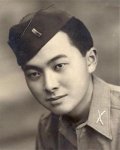
Private Joe Hayashi, serving in the all-Nisei 442nd Regimental Combat Team near Tendola, Italy (alongside Daniel Inouye), exposed himself to hostile fire on April 20, 1945 in order to direct mortar fire onto enemy positions. Two days later (April 22), he single-handedly silenced three hostile machine guns but was killed while pursuing enemy soldiers. For his actions he was posthumously awarded the Medal Of Honor. Here is his citation:
“Private Joe Hayashi distinguished himself by extraordinary heroism in action on 20 and 22 April 1945, near Tendola, Italy. On 20 April 1945, ordered to attack a strongly defended hill that commanded all approaches to the village of Tendola, Private Hayashi skillfully led his men to a point within 75 yards of enemy positions before they were detected and fired upon. After dragging his wounded comrades to safety, he returned alone and exposed himself to small arms fire in order to direct and adjust mortar fire against hostile emplacements. Boldly attacking the hill with the remaining men of his squad, he attained his objective and discovered that the mortars had neutralized three machine guns, killed 27 men, and wounded many others. On 22 April 1945, attacking the village of Tendola, Private Hayashi maneuvered his squad up a steep, terraced hill to within 100 yards of the enemy. Crawling under intense fire to a hostile machine gun position, he threw a grenade, killing one enemy soldier and forcing the other members of the gun crew to surrender. Seeing four enemy machine guns delivering deadly fire upon other elements of his platoon, he threw another grenade, destroying a machine gun nest. He then crawled to the right flank of another machine gun position where he killed four enemy soldiers and forced the others to flee. Attempting to pursue the enemy, he was mortally wounded by a burst of machine pistol fire. The dauntless courage and exemplary leadership of Private Hayashi enabled his company to attain its objective. Private Hayashi's extraordinary heroism and devotion to duty are in keeping with the highest traditions of military service and reflect great credit on him, his unit, and the United States Army.”
Hayashi, aged 24 at his death, was buried in Evergreen Cemetery, Los Angeles, California. He was posthumously promoted to Sergeant.

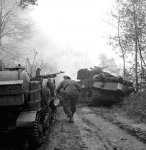
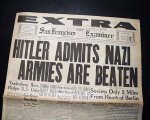
Pictured: Infantrymen of Support Company, The Queen's Own Cameron Highlanders of Canada, supported by a Sherman tank of The Fort Garry Horse, advancing south of Hatten, Germany, April 22, 1945.; Raising the American flag over swastika at Nuernberg stadium, April 22, 1945. This is the very spot from which Hitler, Goering, Gobbels and Hiimmler harangued their massive Nazi audiences at party festivals in the defiant prewar days. After the U.S. forces had crushed the last flicker of enemy resistance in the city, masses of liberated foreign slave workers streamed into the huge stadium.; San Francisco Examiner headline from April 22, 1945.; Medal Of Honor recipient Joe Hayashi.

0422a.jpg0422b.jpg0422c.jpg0422d.jpg
 
It says Hyashi was a private but isn't that a sergeant's insignia?

I wonder how the SF Examiner got wind of Hitler's submission?

I always assumed the massive crowds were in Berlin.
 
In the 1970s, there was a car dealer in Richmond who sold Hondas and Volkswagens. His advert slogan was "From those wonderful folks who brought you World War II."
This was the 1970s, so there were still a number of WW II vets around, but I guess they were selling a decent product and hatreds had faded.
I'd say that it had largely faded by the 70s. Huntsville got over the German prejudice quickly with the arrival of the von Braun team...
 
  • Like
Reactions: crimsonaudio
It says Hyashi was a private but isn't that a sergeant's insignia?

I wonder how the SF Examiner got wind of Hitler's submission?

I always assumed the massive crowds were in Berlin.
It looks like at least a staff sergeant and possibly a tech. The rallies in Nürnberg were before the Nazi takeover of the government. They then did move to Berlin...
 
  • Thank You
Reactions: Go Bama
Advertisement

Trending content

Advertisement

Latest threads