75th anniversary of D-Day...

April 1, 1945:... P-47D Thunderbolt of the 367th Fighter Squadron made a belly landing in field artillery position after being hit in the left wing during a dive bombing attack on near Würzburg, Germany, 1 Apr 1945. The pilot was only slightly injured.; View attachment 7002
That's a landing that, if you survive it, you have a cigarette, even if you don't smoke.
I would be thinking, "Okay, well, maybe I'll just take my time getting back to my base and maybe this war will be over before I have to get back in a cockpit again."
 
Back in January, my SIL and grandson drove about 45 minutes north into Haute Savoie and literally skied down into Italy. I had forgotten about the ME's engine problems. I'm sure the ten hours is MTTF. That would lead to piloting in a state of anxiety...
Additionally, the German higher ups kept fiddling with the design of the ME delaying its deployment.
 
Additionally, the German higher ups kept fiddling with the design of the ME delaying its deployment.
While Germans tend to have many virtues, "overengineering" is something of a national trait for them.
One of my German colleagues was aghast when I pointed this out in regards to my Mercedes rental car. I called it an "over engineered German piece of crap." The owner's manual is the size of the NY City phone book. If you turn on the windshield wipers, and the hi beams and tune the radio to 97.1, the car will lower the tire pressure in the tires 10 psi, and the car will generate pick-up lines auf Deutsch and tell your horoscope.
I told him I'd rather drive a Renault. He seemed genuinely wounded by that.
 
That's a landing that, if you survive it, you have a cigarette, even if you don't smoke.
I would be thinking, "Okay, well, maybe I'll just take my time getting back to my base and maybe this war will be over before I have to get back in a cockpit again."
The younger of my two older brothers, the fighter-bomber pilot, survived one belly landing. His stories of training accidents were hair-raising - pilots sitting planes down on top of another, that sort of thing. We almost had a civilian belly landing in Digital Engineering, back in the early '80s. We did nuclear engineering and one of our clients was a plant in Gentilly, Quebec. Our CEO had flown our Piper Navajo up in the winter and was on the way back, unaware that his landing gear was frozen in place. He hadn't had to make a refueling stop, because the Navajo's range easily covered the distance. When he got to HSV, he discovered the problem. Fortunately, the temperature here was above freezing at low altitude. He had reason to celebrate those big tanks (he'd filled up in Quebec), because he was able to descend to above-freezing altitude and circle the airport until the gear thawed. Also, if he had to make a gear-up landing, those tanks needed to be as empty as possible. Adding to the drama was the fact that his father was the air controller on duty, so he had to helplessly watch his son circle overhead...
 
While Germans tend to have many virtues, "overengineering" is something of a national trait for them.
One of my German colleagues was aghast when I pointed this out in regards to my Mercedes rental car. I called it an "over engineered German piece of crap." The owner's manual is the size of the NY City phone book. If you turn on the windshield wipers, and the hi beams and tune the radio to 97.1, the car will lower the tire pressure in the tires 10 psi, and the car will generate pick-up lines auf Deutsch and tell your horoscope.
I told him I'd rather drive a Renault. He seemed genuinely wounded by that.
LOL! I drove their diesels for 30 years and I hear you. The earlier ones were much simpler machines, but the last one I had was constantly stepping on itself... :)
 
The younger of my two older brothers, the fighter-bomber pilot, survived one belly landing. His stories of training accidents were hair-raising - pilots sitting planes down on top of another, that sort of thing. We almost had a civilian belly landing in Digital Engineering, back in the early '80s. We did nuclear engineering and one of our clients was a plant in Gentilly, Quebec. Our CEO had flown our Piper Navajo up in the winter and was on the way back, unaware that his landing gear was frozen in place. He hadn't had to make a refueling stop, because the Navajo's range easily covered the distance. When he got to HSV, he discovered the problem. Fortunately, the temperature here was above freezing at low altitude. He had reason to celebrate those big tanks (he'd filled up in Quebec), because he was able to descend to above-freezing altitude and circle the airport until the gear thawed. Also, if he had to make a gear-up landing, those tanks needed to be as empty as possible. Adding to the drama was the fact that his father was the air controller on duty, so he had to helplessly watch his son circle overhead...
Lesson: don't fly to Quebec in the winter.
 
  • Like
Reactions: crimsonaudio
LOL! I drove their diesels for 30 years and I hear you. The earlier ones were much simpler machines, but the last one I had was constantly stepping on itself... :)
When driving a rental car I'm only going to use for a couple of weeks, I want simple.
A Renault has a gas pedal, a break pedal, steering wheel, and an ignition switch. Simple.
Now, if i am going to own the car until it has 200,000 km, I'd rather have the Mercedes. Maybe I could read the entire owner's manual in that time.
 
Lesson: don't fly to Quebec in the winter.
The earlier nuclear plants were built right in the middle of things - Indian Point, Three Mile Island, etc. Later, they caught on and started placing them in out of the way locations, IOW the Boonies. Commercial flights always meant long flights, with many legs and then vehicle rental for long distances. General aviation was a practical necessity, including flights to Quebec in winter...
 
When driving a rental car I'm only going to use for a couple of weeks, I want simple.
A Renault has a gas pedal, a break pedal, steering wheel, and an ignition switch. Simple.
Now, if i am going to own the car until it has 200,000 km, I'd rather have the Mercedes. Maybe I could read the entire owner's manual in that time.
If one prices replacement of normal wear items on a Mercedes such as emission controls, tires, brakes, etc. they find out quickly that parts plus labor to install require a very healthy budget. The per mile operating cost to travel 200,000 KM would be off the charts. My budget would have me choosing the Renault if those were the options I had.
 
If one prices replacement of normal wear items on a Mercedes such as emission controls, tires, brakes, etc. they find out quickly that parts plus labor to install require a very healthy budget. The per mile operating cost to travel 200,000 KM would be off the charts. My budget would have me choosing the Renault if those were the options I had.
The last one I had was a turbo diesel. Eventually, the turbo went. There were exactly two in the country, about 15 years ago. They were both used and came with no warranty. At that point, I sold the car to my mechanic at a bargain price...

Edit: The price was $1600 each...
 
Last edited:
The last one I had was a turbo diesel. Eventually, the turbo went. There were exactly two in the country, about 15 years ago. They were both used and came with no warranty. At that point, I sold the car to my mechanic at a bargain price...
My son drives a 1981 Mercedes with 154,000 miles on it.
Simple and reliable. I think Mercedes has lost its way.
 
  • Like
Reactions: B1GTide
I had an 1981 300D. Good car. Should have kept it...
To get us back on the topic a bit. The Soviets, when they produced the KV-1 discovered it would not go into gear unless the gear shirt was hammered into place by a ten-pound sledgehammer. Soviet solution? Issue a ten-pound sledgehammer with each tank.
The German solution, take the plans back into the lab and redesign the tank.
Soviet T-34 tank production during World War II: 58,701 tanks.
German Pzkw Mark IV & V tank production during World War II: 19,868
 
Last edited:
April 2, 1945: On the western front, the British 2nd Army continues its advance north of the Ruhr River. Munster is taken. The Canadian 1st Army also begins to move north and east from between Nijmegen and Emmerich, attacking toward Arnhem, Doesburg, and Zutphen. US 9th Army is attacking around Muenster and Neuhaus and , along with US 1st Army, tightening its grip on the Ruhr pocket. Patton’s US 3rd Army attacks into Kassel, Grimmenthal, and Vachdorf and mops up previously bypassed pockets. US 7th Army continues attacking Aschaffenburg while pushing toward Wuerzburg, Marienburg, Koenigshofen, Homburg, Heilbronn, and Bockingen. French 1st Army expands its bridgehead and conducts new assault across the Rhine near Leimersheim.

Above Germany, US 15th Air Force attacks rail yards and bridges with nearly 600 bombers while RAF Bomber Command sends 54 aircraft to attack Berlin overnight and 50 aircraft to attack Magdeburg overnight.

On the eastern front - with assistance from Bulgarian units, 57th Army of Soviet 3rd Ukrainian Front captures the main Hungarian oil production area near Magykanizsa, while in Slovakia, Kremnica is captured. Troops from the 46th Army of Soviet 2nd Ukrainian Front captures the Hungarian industrial zone of Mosonmagyarovar. 6th Guards Tank Army of 3rd Ukrainian Front reaches Lake Neuseidler. Soviet troops capture Wiener Neustadt, Eisenstadt, Neunkirchen, and Gloggnitz in southern Germany, and are now threatening Vienna. Soviet artillery continues pounding Koenigsberg in preparation for major assault.

Round-the-clock work on a vast new Fuehrerbunker southeast of Weimar near the Ohrdruf slave labor camp in eastern Germany come to an end when 9,000 inmates are forced-marched to the parent Buchenwald death camp 32 miles away. It was from this still unfinished headquarters that Hitler and other Nazi leaders had hoped to strike a deal with the western Allies to join the remnants of the Wehrmacht in fighting the “Jewish-Bolshevik” Soviet Union.

Folke Bernadotte meets with Heinrich Himmler at the SS Hohenlychen sanatorium in Lychen, Germany; Himmler is unsuccessful in convincing Bernadotte to help seek a peace between Germany and the Western Allies. Meanwhile, Martin Bormann orders Germany to fight until victorious or until death.

In his bunker, Hitler predicts the complete destruction of Germany

In Italy, Operation Roast continues as British 8th Army successfully captures the bridgehead west of Lake Comacchio. Overhead, US 12th Air Force aircraft attack transportation lines, supply depots, methanol plants, and other targets in the Po valley and elsewhere in northern Italy, including Fornovo di Taro, San Michele all'Adige, Colle Isarco, and other targets.

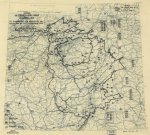
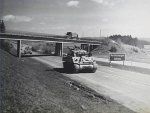
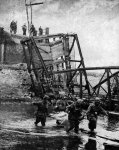
Pictured: 11th Armored Division tanks entering Bavaria, Germany, enjoying the great roads.; British 6th Airborne Division crosses the Dortmund-Ems Canal ten miles south of Osnabruk. Ittenbach, Germany.: the ceremony for Major General Maurice Rose, who was killed in action on March 30, 1945, in the advance on Paderborn, Germany. Only 45 years old at the time, had led his 3rd Armored "Spearhead" Division through France and Belgium, and then becoming the first Allied ground force to invade German soil in WWII. Later in 1945, his body was re-interned in Margraten, The Netherlands, as all American servicemen buried in Germany were re-interned outside of Germany; Situation map from April 2, 1945.
0402a.jpeg
0402b.jpeg
0402c.JPG
0402d.jpeg
 
I had these photos in my shoe box. My Dad had written on the back German 12th Panzer Division. Obviously not much detail here but April is the time that soldiers on both sides began to think making it home alive.

German 12 Panzer 2.jpeg
 
I had these photos in my shoe box. My Dad had written on the back German 12th Panzer Division. Obviously not much detail here but April is the time that soldiers on both sides began to think making it home alive.

View attachment 7038
Must have been the 12th SS Panzer Hitlerjugend.
12th Panzer (Wehrmacht) was in the Courland Peninsula in April 1945.
 
  • Like
Reactions: TIDE-HSV
Must have been the 12th SS Panzer Hitlerjugend.
12th Panzer (Wehrmacht) was in the Courland Peninsula in April 1945.
I do not have an exact date for the photos or manner in which German Divisions were organized for processing after VE Day. The 244th was assigned duty at Cham Prisoner of War Camp upon returning from Czechoslovakia after VE Day. This photo could have been taken as German prisoners arrived at Cham for processing. I have some other distant photos at Cham. One is labeled German 12th Army as prisoners Cham, Germany 22,000. There are other photos of Buchenwald ( I believe) including the ovens that I will share over the next weeks.
 

New Posts

Advertisement

Trending content

Advertisement

Latest threads